A text-book of animal physiology : with introductory chapters on general biology and a full treatment of reproduction, for students of human and comparative (veterinary) medicine and of general biology / by Wesley Mills ... with over 500 illustrations.
- T. Wesley Mills
- Date:
- 1889
Licence: Public Domain Mark
Credit: A text-book of animal physiology : with introductory chapters on general biology and a full treatment of reproduction, for students of human and comparative (veterinary) medicine and of general biology / by Wesley Mills ... with over 500 illustrations. Source: Wellcome Collection.
Provider: This material has been provided by the Augustus C. Long Health Sciences Library at Columbia University and Columbia University Libraries/Information Services, through the Medical Heritage Library. The original may be consulted at the the Augustus C. Long Health Sciences Library at Columbia University and Columbia University.
31/750 page 1
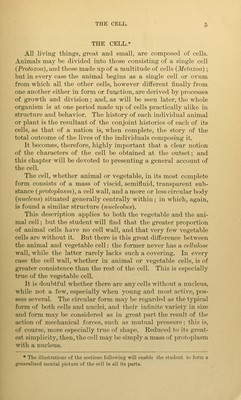
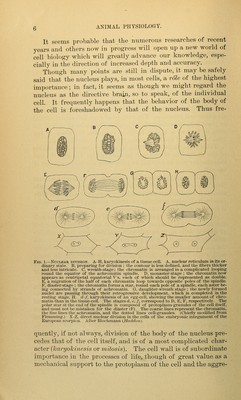
![GENEEAL BIOLOGY. Introduction. Biology {/3lo<;, life; koyos, a dissertation) is the science which treats of the nature of living things; and, since the properties of plants and animals can not be explained without some knowledge of their form, this science includes morphol- ogy {txop(f>r], form; Aoyos, a dissertation) as well as physiology (^uo-is, nature ; Aoyos). Morphology describes the various forms of living things and their parts; physiology, their action or function. General biology treats neither of animals nor plants exclu- sively. Its province is neither zoology nor botany; but it at- tempts to define what is common to all living things. Its aim is to determine the properties of organic beings as such, rather than to classify or to give an exhaustive account of either ani- mals or plants. Manifestly, before this can be done, living things, both animal and vegetable, must be carefully compared, otherwise it would be impossible to recognize differences and resemblances; in other words, to ascertain what they have in common. When only the highest animals and plants are contem- plated, the differences between them seem so vast that they appear to have, at first sight, nothing in common but that they are living: between a tree and a dog an infant can discrimi- nate; but there are microscopic forms of life that thus far defy the most learned to say whether they belong to the ani- mal or tlie vegetable world. As we descend in the organic series, the lines of distinction grow fainter, till they seem finally to all but disappear. But let us first inciuire: What are the determining charac-](https://iiif.wellcomecollection.org/image/b21212867_0031.jp2/full/800%2C/0/default.jpg)