A text-book of animal physiology : with introductory chapters on general biology and a full treatment of reproduction, for students of human and comparative (veterinary) medicine and of general biology / by Wesley Mills ... with over 500 illustrations.
- T. Wesley Mills
- Date:
- 1889
Licence: Public Domain Mark
Credit: A text-book of animal physiology : with introductory chapters on general biology and a full treatment of reproduction, for students of human and comparative (veterinary) medicine and of general biology / by Wesley Mills ... with over 500 illustrations. Source: Wellcome Collection.
Provider: This material has been provided by the Augustus C. Long Health Sciences Library at Columbia University and Columbia University Libraries/Information Services, through the Medical Heritage Library. The original may be consulted at the the Augustus C. Long Health Sciences Library at Columbia University and Columbia University.
65/750 page 35
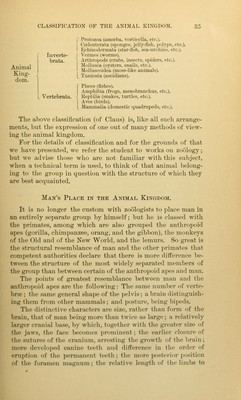
![Animal Kiug- dom. CLASSIFICATION OF THE ANIMAL KINGDOM. 35 f Protozoa (amoeba, vorticella, etc.). j Coelenterata (sponges, jelly-fish, jjolyps, etc.). I Echinodermata (star-fish, sea-urchins, etc.). r Inverte- J Vermes (worms). brata. ] Arthropods (crabs, insects, spiders, etc.). Mollusca (oysters, snails, etc.). Molluscoidea (moss-like animals). [ Tunicata (ascidians). f Pisces (fishes). I Amphibia (frogs, menobranchus, etc.). t Vertebrata. -J Keptilia (snakes, turtles, etc.). I Aves (birds). [ Mammalia (domestic quadrupeds, etc.). The above classification (of Claus) is, like all such arrange- ments, but the expression of one out of many methods of view- ing the animal kingdom. For the details of classification and for the grounds of that we have presented, we refer the student to works on zoology; but we advise those who are not familiar with this subject, when a technical term is used, to think of that animal belong- ing to the group in question with the structure of which they are best acquainted. Man's Place in the Animal Kingdom. It is no longer the custom with zoologists to place man in an entirely separate group by himself; but he is classed with the primates, among which are also grouped the anthropoid apes (gorilla, chimpanzee, orang, and the gibbon), the monkeys of the Old and of the New World, and the lemurs. So great is the structural resemblance of man and the other primates that competent authorities declare that there is more difference be- tween the structure of the most widely separated members of the group than between certain of the anthr(^poid apes and man. The points of greatest resemblance between man and the anthropoid apes are the following: The same number of verte- bree ; the same general shape of the pelvis; a brain distinguish- ing them from other mammals; and posture, being bipeds. The distinctive characters are size, rather than form of the brain, that of man being more than twice as large; a relatively larger cranial base, by which, together with the greater size of the jaw.s, the face becomes prominent; the earlier closure of the sutures of the cranium, arresting the growth of the brain; more developed canine teeth and difference in the order of eruption of the permanent teeth; the more i)osterior position of the foramen magnum; the relative length of the limbs to](https://iiif.wellcomecollection.org/image/b21212867_0065.jp2/full/800%2C/0/default.jpg)