A text-book of animal physiology : with introductory chapters on general biology and a full treatment of reproduction, for students of human and comparative (veterinary) medicine and of general biology / by Wesley Mills ... with over 500 illustrations.
- T. Wesley Mills
- Date:
- 1889
Licence: Public Domain Mark
Credit: A text-book of animal physiology : with introductory chapters on general biology and a full treatment of reproduction, for students of human and comparative (veterinary) medicine and of general biology / by Wesley Mills ... with over 500 illustrations. Source: Wellcome Collection.
Provider: This material has been provided by the Augustus C. Long Health Sciences Library at Columbia University and Columbia University Libraries/Information Services, through the Medical Heritage Library. The original may be consulted at the the Augustus C. Long Health Sciences Library at Columbia University and Columbia University.
87/750 page 57
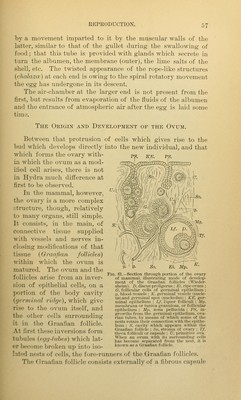
![Idv a movement imparted to it by the muscular walls of the latter, similar to that of the gullet during the swallowing of food; that this tube is provided with glands which secrete in turn the albumen, the membrane (outer), the lime salts of the shell, etc. The twisted appearance of the rope-like structures (chalazce) at each end is owing to the spiral rotatory movement the egg has undergone in its descent. The air-chamber at the larger end is not present from the first, but results from evaporation of the fluids of the albumen and the entrance of atmos]oheric air after the egg is laid some time. The Origin and Development of the Ovum. Between that protrusion of cells which gives rise to the bud which develops directly into the new individual, and that which forms the ovary with- rS. TTE. PS. in which the ovum as a mod- ified cell arises, there is not in Hydra much difference at first to be observed. In the mammal, however, the ovary is a more complex etructure, though, relatively to many organs, still simple. It consists, in the main, of connective tissue supplied with vessels and nerves in- closing m(jdifications of that tissue (Graafian follicles) within which the ovum is matured. The ovum and the follicles arise from an inver- sion of epithelial cells, on a portion of the body cavity (fjerminal ridge), which give rise to the ovum itself, and the other cells surrounding it in the Graafian follicle. At first these inversions form tubules (egg-tubes) which lat- er bec(;nie broken up into iso- lated nests of cells, the ft^re-runners of the Graafian follicles. The Graafian follicle consists externally of a fibrous cai)sule Ei. Mp. • Fig. 61.—Section through portion of the ovary of mammal, illustrating mode of develop- ment of the Graafian follicles (Wieder- sheim). D, discus proligerus ; Ei, ripe ovum ; (t, follicular cells of germinal epithelium ; (I, blood-vessels : A', germinal vesicle (nucle- us) and germinal spot (nucleolus): KE. ger- minal epithelium : Lf. Ifquor folliculi ; Afg, membrana or tunica granulosa, or follicular epithelium ; Mik zona pellucida : PS, in- grf)wths from tlie germinal ei)ithelium, ova- rian tubes, liy means of which some of the nests retain tlieir connection with the epithe- lium : .S, cavity which appears within the Graafian folli<;le ; .So, stroma of ovary ; Tf, theca follicidi or capsule ; U, primitive ova. When an ovum with its surrounding cells ha« becf)me se[)arated from the nest, it is known a« a Graafian follicle.](https://iiif.wellcomecollection.org/image/b21212867_0087.jp2/full/800%2C/0/default.jpg)