Lexikon der Kohlenstoff-Verbindungen. Supplement III, Umfassend die Litteraturjahre 1903 und 1904 / von M.M. Richter.
- Max Richter
- Date:
- 1905
Licence: In copyright
Credit: Lexikon der Kohlenstoff-Verbindungen. Supplement III, Umfassend die Litteraturjahre 1903 und 1904 / von M.M. Richter. Source: Wellcome Collection.
25/518 (page 11)
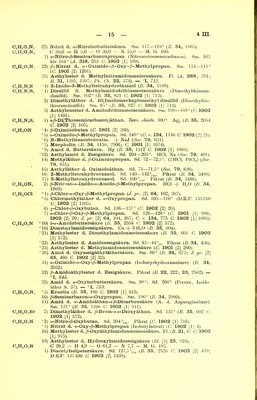
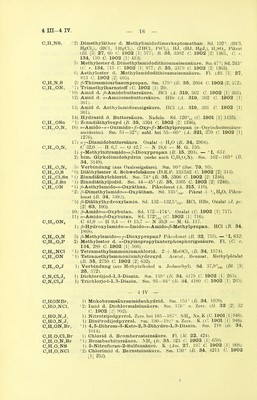
![c4h8o, C4H8Os C4H8N(i C,H8Br, C(HSJ., C4H9]Sf C4H0C1 C4H9Br C.HigO c4h1(Io2 c4h1I(o4 c4h10s C4HnN C,04Ni c4nsrci, c4n2ci4 C4J5T,Br4 C,,HNBr4 C4H,OBr6 C4H'OJ2 c4h.,o,n4 C4H,03Br., c4h,o4n, C,H,0,N, C,H,OtjN, C4H.,N4Pt c4h3o:)n c,H..o,]sr.. C^JS C4H4OCl4 *14) ?-Dioxybuttersäure (B. 34, 1430). 16) 1-Threose (B. 34, 1370). *4) d-Erythronsäure (Soc. 81, 671 G. 1902 [2] 109). 8) 1-Erythronsäure. Brucinsaiz (B. 34, 1368). 2) 2,4,5,6-Tetraamido-l,3-Diazin. Sm. 205°. 3HCl, Pikrat (B. 34. 3365). *2) rey-Dibrombutan. Sd. 170-174° (C. 1902 |1] 1277. *3) a(5-Dibrombutan. Sd. 196—197° u. Zers. (C. 1901 [1| 610; 1901 |2| 807; 1902 [1] 914). *6) a (9-Dibrom-(?-Methylpropan (B. 34, 4217 G. 1902 [1] 175). 2) «Ö-Dijodbutan. Sd. 125—126 °16 (C. 1901 [1] 610). 8) l-Amidomethyl-R-Trimethylen. Sd. 88°. HCl, (2HCl, PtCl4) (C. 1901 [1] 1357; 1902 [1] 913). *2) (9-Chlorbutan. Sd. 67,3-67,8°767 (Am. 26, 307). *2) (?-Brombutan. Sd. 91,3° (Am. 26, 308). *1) «-Oxybutan (G. r. 133, 300; B. 35, 694 G. 1902 [1] 709). *2) (?-Oxybutan. Sd. 99,7-99,9° (Am. 26, 306). *3) Isobutylalkohol. Zn, 4 + A1,C18 (Bl. [3] 25, 555; G. 1901 [2] 1201; M. 23, 797 O. 1902 [2] 1093). *4) j^-Oxy-p’-Methylpropan (C. 1901 [1] 930; 1901 [2] 623). *2) ay-Dioxybutan. Sd. 204-204,5° (M. 22, 63). *3) a<5-Dioxybutan (Tetramethylenglykol). Sm. 16°; Sd. 230°760 (C. 1901 [1] 818; B. 35, 1187 C. 1902 [1] 1011). *4) ßy-Dioxybutan. Sd. 185° (G. r. 134, 472 G. 1902 [1] 743). *5) «($-Dioxy-(9-Methylpropan. Sd. 175—177 (G. 1902 [1] 628). *1) i-Erythrit (Soc. 81, 187 G. 1902 [1] 576). *2) r-Erythrit. Sm. 72° (Bl. [3] 25, 743). *3) d-Erythrit (Bl. [3] 25, 740). *4) 1-Erythrit (Bl. [3| 25, 740). *6) Diäthylsulfid (C. 1901 [1] 367). *1) Butylamin (G. 1902 [1] 3). *3) Isobutylamin (C. 1902 [1] 3, 914). *6) Diäthylamin. 2 HCl -f MoOC13 (B. 34, 1574 G. 1902 [1] 3). 8) d-^-Amidobutan. HCl, (2 HCl, PtCl4) (G. 1901 [2] 28). 9) ^-Methylamidopropan (Methylisopropylamin). HCl, (2 HCl, PtCl4), (HCl, AuCl,), Pikrat (Soc. 79, 640). 10) Dimethylamidoäthan (Dimethyläthylamin). Sd. 28—30° (G. 1902 [2] 1403). *1) Kohlenoxydnickel (Ph. Ch. 40, 1 G. 1902 [1] 903). *1) Pentachlorpyrrol. Sd. 209° (G. 32 [2] 30 C. 1902 [2] 902). *1) 2,4,5,6-Tetrachlor-l, 3-Diazin. Sm. 70° (B. 34, 4178 C. 1902 [1] 265). 1) 2,4,5,6-Tetrabrom-l,3-Diazin. Sm. 165—166° (B. 34, 4180 C. 1902 [1] 265). - 4 III - 1) 2,3,4,5-Tetrabrompyrrol (C. 1901 [1] 1323). *2) Hexabromtetrahydrofuran. Sm. 112° (Am. 25, 456). 1) 2,5-Dijodfuran. Sm. 47° (Am. 25, 457). 2) Verbindung (aus Acetylen). Sm. 108° (G. 32 [1] 203 G. 1901 [2] 178). *3) Mueobromsäure (B. 34, 1632). *1) Alloxan (B. 34, 3290; G. 1902 [1] 631). 3) 2,5-Dinitrofuran? Sm. 101° (Am. 27, 198 G. 1902 [1] 908; C. r. 135, 507 G. 1902 [2] 1098). C 27,6 — H 1,1 — O 55,1 — N 16,1 — M. G. 174. 1) Bisanhydronitroessigsäure. Explod. bei 70°. K, -)- 3H20 (B. 34, 877). 1) Platinblausäure. Salze meist bek. Lit. bed. — I, 1429\ *1, 798. C 42,5 — H 2,6 — O 42,5 - N 12,4 - M. G. 113. 1) 3-Nitrofuran. Sm. 28° (G 1901 [1] 466; G. r. 134, 777 C. 1902 [1] 1107). 2) Verbindung (aus Acetylen). Sm. 149° (G. 32 [1] 204 G. 1901 [2] 178). *5) Violursäure (B. 35, 1004 G. 1902 [1] 868). *1) 2-Jodthiophen. Sd. 73°15 (J. pr. [2] 65, 6 C. 1902 [1] 458). 3) Chlorid d. ?-Trichlorisobuttersäure. Sd. 110—114°154 (B. 34, 4055).](https://iiif.wellcomecollection.org/image/b28126543_0027.jp2/full/800%2C/0/default.jpg)