Our homes and how to make them healthy / by R. Brudenell Carter [and others] ; edited by Shirley Forster Murphy.
- Date:
- 1883
Licence: Public Domain Mark
Credit: Our homes and how to make them healthy / by R. Brudenell Carter [and others] ; edited by Shirley Forster Murphy. Source: Wellcome Collection.
Provider: This material has been provided by the Royal College of Physicians of Edinburgh. The original may be consulted at the Royal College of Physicians of Edinburgh.
942/972 (page 924)
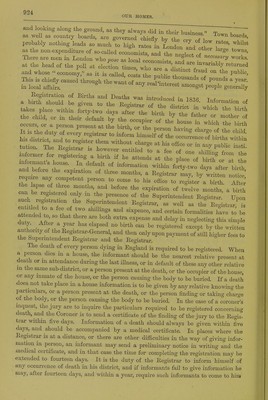
![OUR HOMES. t and looking along the ground, as they always did in their business Tow. T.~T as ^yell as country boards, are governed chiefly by the crv n 1. T f^^'' probably nothing leads so much to high rates L Londo. l i T*'' as the non-expenditure of so-called econon. sts and the neXt of ^ There are men in London who vose as ]nf>«l ... 7 T '^^^^^s^'^'-^/ ^vorks. at the head of the poll at elec^on t m^ 7°^^.^^^ ^^e invariably returned and whose economy^^ a itt cal^^^^^^^^ tf '^^ - the public. This is chiefly causecf'through the wlni of anf ^^^^^^^^ r'^ ^^^'^^ ^ in local afi-airs. ^ ^^^^ P^ople generally Registration of Births and Deaths was introduced in IR'^fi T f . a birth should be given to the Registrar I iT r . ! I^fo™ation of takes place within Ly-two days X the birth b^tTe /:,^ ''^^ t.e child, or in their default by%he occu^ ^^he^t^se^^ll^^Ib ^^^^^^^^^^ informer for registering a birth if Tfl^ ^ Z ^ acToft^r o^a: tt informant's Ijouse. In default of information within forty-two days after bix^h ^d before the expiration of three months, a Registrar may, b/wriUen not e' require any competent person to come to his office to regfs'terVb^th Ift?; the apse of three months, and before the expiration of twelve months a toth can be registered only in the presence of the Superintendent RegS^S; Upon su h registration the Superintendent Registrar, as well as the Reg strar' a tended to, so that there are both extra expense and delay in neglecting this simple duty. After a year has elapsed no birth can be registered except by the written authority of the Registrar-General, and then only upon payment of still higher fees to the Superintendent Registrar and the Registrar. The death of every person dying in England is required to be registered. When a person dies in a house, the informant should be the nearest relative present at death or m attendance during the last illness, or in default of these any other relative in the same sub-district, or a person present at the death, or the occupier of the house or any inmate of the house, or the person causing the body to be buried. If a death does not take place in a house information is to be given by any relative knowing the particulars, or a person present at the death, or the person finding or taking charge of the body, or the person causing the body to be buried. In the case of a coroner's inquest, the jury are to inquire the particulars required to be registered concerning death, and the Coroner is to send a certificate of the finding of the jury to the Regist trar Mdthin five days. Information of a death should always be given within five days, and should be accompanied by a medical certificate. In places where the Registrar is at a distance, or there are other difficulties in the way of giving infor- mation in person, an informant may send a preliminary notice in writing and the medical certificate, and in that case the time for completing the registration may be extended to fourteen days. It is the duty of the Registrar to inform himself of «ny occurrence of death in liis district, and if informants fail to give information lie may, after fourteen days, and within a year, requii-e such informants to come to him](https://iiif.wellcomecollection.org/image/b21958300_0942.jp2/full/800%2C/0/default.jpg)