Alexander the corrector's humble address and earnest application to our most gracious King, the Right Honourable the House of Lords, and the Honourable House of Commons; shewing the necessity of appointing a corrector of the people, or taking some effectual measures for a speedy and a thorow reformation ... With some account of Alexander the corrector / [Alexander Cruden].
- Alexander Cruden
- Date:
- 1755
Licence: Public Domain Mark
Credit: Alexander the corrector's humble address and earnest application to our most gracious King, the Right Honourable the House of Lords, and the Honourable House of Commons; shewing the necessity of appointing a corrector of the people, or taking some effectual measures for a speedy and a thorow reformation ... With some account of Alexander the corrector / [Alexander Cruden]. Source: Wellcome Collection.
61/186 page 9
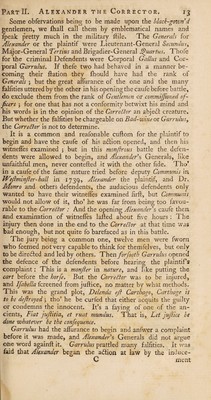
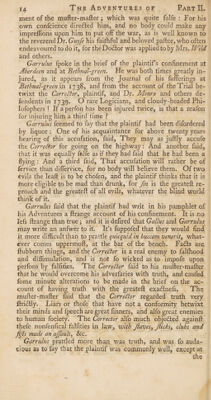
![mifer is not at prefent to be inquired into. The Corrclior in his propofals of reconciliation did not (hew a covetous temper \ for he was defirous that the criminal Ifabella fhould be com¬ mitted to prifon for fpme time and pay a fmall fum of money. Topunifh the perfon and pocket is the wayto affedf criminals, and to deter others from committing the like crimes. It may be juftly faid that even a war between a plaintif and a defendent in Wefl?ninfer-hall is very undefirable, the event being generally very uncertain ; and this war, as with real military war, drains the pockets of the parties engaged. The officers in the hall receive the money, the chief of whom ap¬ pear with a black-gown and a band, and chiefly or rather al¬ together fight with a woman’s weapon, namely the tongue. It is allowed that in difficult points of law it maybe necef- fary to confult thofe black-gowns, as the honourable houfe of Lords confult the judges ; tho’ the Corrector be convinced that fome plaintifs knowing the fecret fprings and motives of adfions, could examine the witnefTes and defend their caufe better than the black-gowns : And in the next battle Alexander deftgns to begin the attack and purine it himfelf. It is alfo allowed that the Captain-general or Commander in chief may fometimes confult the inferior Generals: For the great and fovereign God can make ufe of what inftruments he pleafes, and he will fend by.whom he will fend ; and who may fay to him what doft thou ? It is the language of fcripture and the experience of all ages, that in fpiritual and religious matters God generally makes ufe of weak inftruments and enables them to do mo ft good : And even in military affairs an in¬ ferior officer hnay be honoured to have a great hand in the yidlory : As was the cafe when Julius Ccefar invaded our Ifland. sc The ftandard-bearer of the tenth legion perceiving that the Romans were unwilling to venture into the fea, having fir ft: £C invok’d the gods for fuccefs, cried aloud 5 My fellow-fold?.ers ce unlefs you will forfake your Eagle dijhonourably, and fuffer it cc to fall into the hands of the enemy, advance ; for my part / am refolved to do my duty to the commonwealth and my general,. ct Having faid this, he immediately leap’d over-board and ad- vanced towards the Englijh. Whereupon the folcliers en- *6 couraging each other, to prevent fo ftgnal a difgrace, fol- cc lowed his example, which thofe in the next fhip perceiving, <c did the like, and preffed forwards to engage the enemy. [See Cariar s Commentaries, lib. iv, feci, xxiih] There is no¬ thing more powerful than example : the imitation of vir¬ tuous adtions among men proceeds from emulation, and the imitation of bad actions from the corruption of man’s nature. Thefe](https://iiif.wellcomecollection.org/image/b30544191_0061.jp2/full/800%2C/0/default.jpg)
 No text description is available for this image
 No text description is available for this image
 No text description is available for this image