Lessons and experiments on scientific hygiene and temperance for elementary schoolchildren / by Helen Coomber.
- Coomber, Helen.
- Date:
- 1914
Licence: In copyright
Credit: Lessons and experiments on scientific hygiene and temperance for elementary schoolchildren / by Helen Coomber. Source: Wellcome Collection.
Provider: This material has been provided by The University of Leeds Library. The original may be consulted at The University of Leeds Library.
166/192 page 142
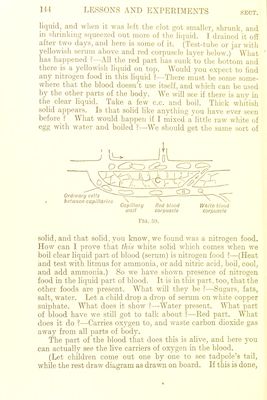
![SKCT. XXXVl Where does the euer-^y come fT'om ?—Oxidation of food. What, lirmo-s the food to the cell pvotophisin of tiie lum, leg, etc. The blood. What else is wanted for oxidation besides piirphsli red ?—In the arm, or leg, or bi-aiu, or digestive tube which is growing or working. And what will be formed in tliose parts of the body where food is being oxidised ?—Carbon dioxide gas and water. Do you think they will stop in the cells where they are made No, they are mostly waste, and must be got rid of, the water passing through special passages, partly from the skin as perspiration, and ])artly through the lungs and windpipe when you breathe out. How do you cet rid of the carbon dioxide gas ? How did you discover that foods were oxidised in the body ?—By breathing into lime- water (like this), and seeing that you breathe out carbon dio.xide gaS, for your breath turns lime-water milky. Where has that breath come from ?—Up the windpipe from the Imigs. So that is where the carbon dioxide gas has come fi-om. How did it get there from the arms, or leg, or brain where it was made ? You can't do an experiment which shows this, so I must tell you. The carbon dioxide gas is carried to the hmgs by the blood. When the blood gives up oxygen it has the power to collect the waste carbon dioxide gas and carry it away. If it were not carried away the protoplasm would be poisoned by it, as it is by alcohol, and could not do its work of building up anew bone and muscle, or of oxidising the food, and so providing the energy for growth and movement. If proto- plasm couldn't do this what would happen ?—It would die, i.e. your body would die. Equally, of course, the protoplasm would die if it had no oxygen or no food. Write down the three things which blood-stream does, without any one of which body would die. It carries oxygen to protoplasm of every part of body ; it carries food to every part of body ; it carries carbon dioxide gas from every part of body.](https://iiif.wellcomecollection.org/image/b21508513_0166.jp2/full/800%2C/0/default.jpg)