Lessons and experiments on scientific hygiene and temperance for elementary schoolchildren / by Helen Coomber.
- Coomber, Helen.
- Date:
- 1914
Licence: In copyright
Credit: Lessons and experiments on scientific hygiene and temperance for elementary schoolchildren / by Helen Coomber. Source: Wellcome Collection.
Provider: This material has been provided by The University of Leeds Library. The original may be consulted at The University of Leeds Library.
172/192 page 148
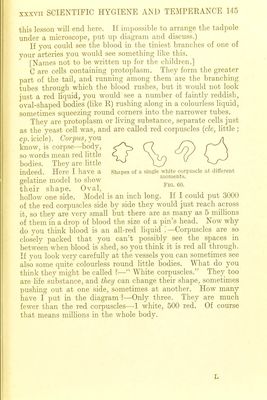
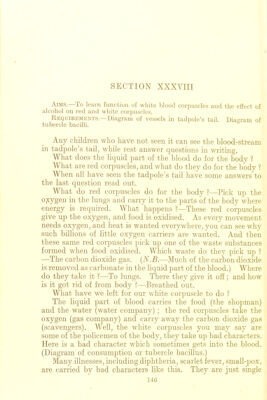
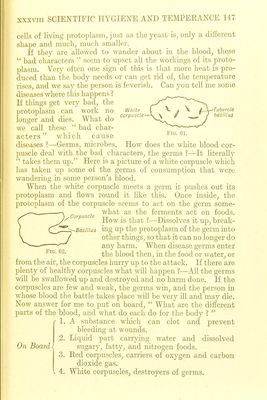
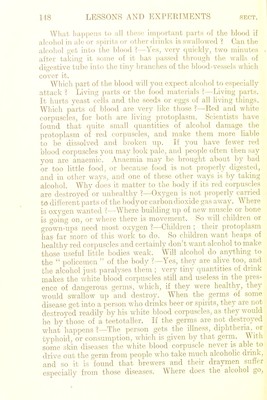
![Whiib li;i|)|)('iis III thesis iin])Oi-t;int pai'ts of t!ic blood if alcohol in alo or spiriLs or othor drinks is swallowed ? Can the alcohol get into the blood ?—Yes, veiy t|uickly, two minutes , after takni; it some of it has ])assed through the walls of digestive tube into the tiny branches of the blood-vessels which cover it. Which part of tbe blood will you expect alcohol to especially attack ? Living parts or the food materials ?—Living parts. It hurts yeast cells and the seeds or eggs of all living things. Which parts of blood are very like those ?—Red and white corpuscles^, for both are living protoplasm. Scientists have found that quite small quantities of alcohol damage the protoplasm of red corpuscles, and make them more liable to be dissolved and broken up. If you have fewer red blood corpuscles you may look pale, and people often then say you are anaemic. Anaemia may be brought about by bad or too little food, or because food is not properly digested, and in other ways, and one of these other ways is by taking alcohol. Why does it matter to the body if its red corpuscles are destroyed or unhealthy ?—Oxygen is not properly carried td different parts of the body or carbon dioxide gas away. Where is oxygen wanted ?—Where building up of new muscle or bone is <Toing on, or where there is movement. So will children or grown-ups need luost oxygen ?—Children ; their protoplasm has far more of this work to do. So children want heaps of healthy red corpuscles and certainly don't want alcohol to make those useful little bodies weak. Will alcohol do anything to the policemen of the body Yes, they are alive too, and the alcohol just paralyses them ; very tiny quantities of drink makes the white blood corpuscles still and useless in the pres- ence of dangerous germs, which, if they were healthy, they would swallow up and destroy. When the germs of some disease get into a person who drinks beer or spirits, they are not destroyed readily by his white blood corpuscles, as they would be by those of a teetotaller. If the germs are not destroyed what happens ?—The person gets the ilhiess, diphtheria, or typhoid, or consumption, which is given by that germ. With some skin diseases the white blood corpuscle never is able to drive out the germ fi-om people who take much alcoholic drink, and so it is found that brewers and their draymen suffer especially from those diseases. Where docs the alcohol go,](https://iiif.wellcomecollection.org/image/b21508513_0172.jp2/full/800%2C/0/default.jpg)