The nature of the shoulder girdle and clavicular arch in Sauropterygia / by H.G. Seeley.
- Harry Govier Seeley
- Date:
- [1892]
Licence: Public Domain Mark
Credit: The nature of the shoulder girdle and clavicular arch in Sauropterygia / by H.G. Seeley. Source: Wellcome Collection.
Provider: This material has been provided by The Royal College of Surgeons of England. The original may be consulted at The Royal College of Surgeons of England.
16/36 page 132
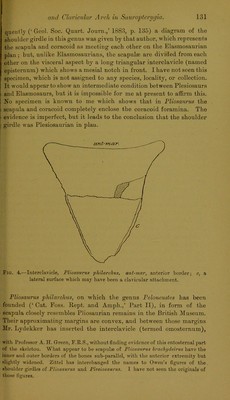
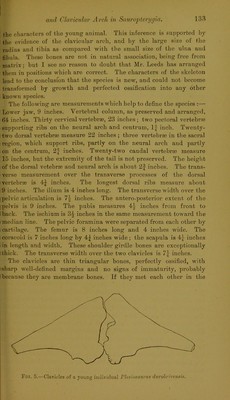
![which is triangular, flat, very thin, and has perfectly straight sides, which, in their hinder approximating two-thirds, are sliglily bevelled. There is no evidence given that the bone occupied the position which has been figured, and I see no reason for believing that it was not placed, as in other Sauropterygians, on the visceral surface of the slightly inclined scapulse, where there is a doubtful indication of what may be an imperfectly preserved right clavicle. If the straight lateral border of the interclavicle was in contact with the flat visceral surface of the scapula, the bones would be in harmonious relation. The bevelled margin appears to look inward, and is therefore inferred to have given attachment to a lateral ossification which was still more delicately thin. This condition is shown in the following 1 figure of the bone. (iii.) A third modification of the Plesiosaurian type maybe* in- dicated by the specimen in the Leeds Collection in the British ] Museum numbered 36. It is small, and the bones are not sharply || ossified and immature, as Mr. Leeds has always believed. But I have not observed any specimen in his collection which would, with 1 certainty, represent its adult state. The bones of the shoulder girdle are thick, and the scapula and coracoid are formed on the i Plesiosaurian type, in that the inner border of the scapula gives no evidence of a median precoi'acoid prolongation backward to meet the j coracoid. There is no indication that the coracoids and scapula) ' ever met in the median line, even in the supposed adult condition, • since there is no anterior median process to the coracoid; but there is a cartilaginous interval between them in front like that attributed to Pliosaurus. The scapula is a stout triradiate bone with a wide external . process, and in form it resembles the bones attributed to PliosaurmM But the cervical vertebrae have no trace of the Pliosaurian modifica- ; tion, and have the aspect of the vertebrae of Plesiosaurus, except that \ the articulation for the rib is not divided in the cervical region. Some Plesiosaurs from the Lias have shown the closest possible approxima- i tion of those surfaces, but the divided condition of the rib facet did not terminate with the Lias species, since some specimens from the Wealden (which are referred to Gimoliosaurus, ‘ Brit. Mus. Cat. Foss. Kept.,’ ; Part II, p. 227, No. 2,444, No. 26,000) retain the character in a condition • similar to that attributed to Thaumatosaurus carinatus (Zoc. cit., p. 168, ] fig 57). It nmy be that the imperfect ossification causes the facet of bone to appear single in this Oxford Clay fossil, while its cartilaginous terminations during life may have been divided; but so far as the evidence goes it rather suggests a sub-generic modification of the genus Plesiosaurus as indicated by the scapular arch, distinguished by undivided articular heads to the cervical ribs, if the adult preserved * I am not sure that this immature Plesiosaurian type did not, on attaining maturity, become the Elasmosaurian genus Cryploclidus.](https://iiif.wellcomecollection.org/image/b22412700_0018.jp2/full/800%2C/0/default.jpg)