Heredity and eugenics ; a course of lectures summarizing recent advances in knowledge in variation, heredity, and evolution and its relation to plant, animal and human improvement and welfare / by William Ernest Castle, John Merle Coulter, Charles Benedict Davenport, Edward Murray East, William Lawrence Tower.
- Date:
- [1912]
Licence: Public Domain Mark
Credit: Heredity and eugenics ; a course of lectures summarizing recent advances in knowledge in variation, heredity, and evolution and its relation to plant, animal and human improvement and welfare / by William Ernest Castle, John Merle Coulter, Charles Benedict Davenport, Edward Murray East, William Lawrence Tower. Source: Wellcome Collection.
Provider: This material has been provided by the Francis A. Countway Library of Medicine, through the Medical Heritage Library. The original may be consulted at the Francis A. Countway Library of Medicine, Harvard Medical School.
299/332 (page 287)
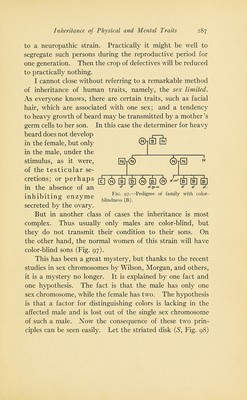
![to a neuropathic strain. Practically it might be well to segregate such persons during the reproductive period for one generation. Then the crop of defectives will be reduced to practically nothing. I cannot close without referring to a remarkable method of inheritance of human traits, namely, the sex limited. As everyone knows, there are certain traits, such as facial hair, which are associated with one sex; and a tendency to heavy growth of beard may be transmitted by a mother's germ cells to her son. In this case the determiner for heavy beard does not develop jcru, in the female, but only ©tS M in the male, under the stimulus, as it were, Ej® ©^[n] n of the testicular se- cretions; or perhaps [e] (n) [b] |b] (n) [b] (n) -^'''/^[b] [b] jb) in the absence of an </ </ ^^« <y. d. d. inhibiting enzyme ^,. /^^- 97.-Pedigree of family with color- ^ •' blindness (B). secreted by the ovary. But in another class of cases the inheritance is most complex. Thus usually only males are color-blind, but they do not transmit their condition to their sons. On the other hand, the normal women of this strain will have color-blind sons (Fig. 97). This has been a great mystery, but thanks to the recent studies in sex chromosomes by Wilson, Morgan, and others, it is a mystery no longer. It is explained by one fact and one hypothesis. The fact is that the male has only one sex chromosome, while the female has two. The hypothesis is that a factor for distinguishing colors is lacking in the affected male and is lost out of the single sex chromosome of such a male. Now the consequence of these two prin- ciples can be seen easily. Let the striated disk {S, Fig. 98)](https://iiif.wellcomecollection.org/image/b21175755_0299.jp2/full/800%2C/0/default.jpg)