A contribution to the medical history of our west African campaigns / by Albert A. Gore.
- Gore, Albert A.
- Date:
- 1876
Licence: Public Domain Mark
Credit: A contribution to the medical history of our west African campaigns / by Albert A. Gore. Source: Wellcome Collection.
Provider: This material has been provided by London School of Hygiene & Tropical Medicine Library & Archives Service. The original may be consulted at London School of Hygiene & Tropical Medicine Library & Archives Service.
218/238 page 204
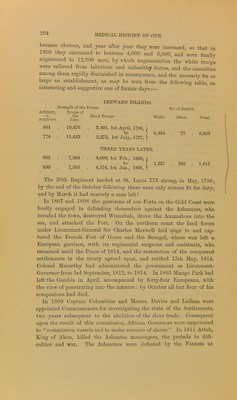
![became obvious, and year after year thoy were increased, so that in 1800 thoy amounted to between 4,000 and 5,000, and were finally augmented to 12,000 men, by which augmentation the white troops were relieved from laborious and unhealthy duties, and the casualties among them rapidly diminished in consequence, and the necessity for so large an establishment, as may be seen from the following table, an interesting and suggestive one of former days:— LEEWARD ISLANDS. Strength of the Forces. Na of Deaths Artillery, V. Artificers. Troops of the Line. Black Troops. White. Black. Total. C01 . 19,070 2,405, 1st April 1790, ' I 774 . 11,633 to 2,373, 1st July, 1797, ] > 0,484 . 75 . 0,858 THREE YEARS LATER. S93 . 7,304 . 4,099, 1st Feb., 1800, ] | 850 . 7,585 to . 4,574, 1st Jan., 1801, ; > 1,221 . 280 . 1,015 The 30th Regiment landed at St. Lucia 776 strong, in May, 1796; by the end of the October following there were only sixteen fit for duty, and by March it had scarcely a man left! In 1807 and 1808 the garrisons of our Forts on the Gold Coast were busily engaged in defending themselves against the Ashantees, who invaded the town, destroyed Winnebah, drove the Anamaboes into the sea, and attacked the Fort. On the northern coast the land forces under Lieutenant-General Sir Charles Maxwell laid siege to and cap- tured the French Fort of Goree and the Senegal, where was left a European garrison, with its regimental surgeons and assistants, who remained until the Peace of 1814, and the restoration of the conquered settlements in the treaty agreed upon, and ratified 13 th May, 1814. Colonel Macarthy had administered the government as Lieutenant- Governor from 3rd September, 1812, to 1814. In 1805 Mungo Park had left the Gambia in April, accompanied by forty-four Europeans, with the view of penetrating into the interior: by October all but four of his companions had died. In 1809 Captain Columbine and Messrs. Davies and Ledlarn were appointed Commissioners for investigating the state of the Settlements, two years subsequent to the abolition of the slave trade. Consequent upon the result of this commission, African Governors were empowered to “ commission vessels and to make seizures of slaves.” In 1811 Attah, King of Akim, killed the Ashantee messengers, the prelude to diffi- culties and war. The Ashantees were defeated by the Fantees at](https://iiif.wellcomecollection.org/image/b24764589_0218.jp2/full/800%2C/0/default.jpg)