The irritant constituent of anti-leprotic oils / by H. Paget, J.W. Trevan and A.M.P. Attwood.
- Paget, Humphrey.
- Date:
- [1934]
Licence: Public Domain Mark
Credit: The irritant constituent of anti-leprotic oils / by H. Paget, J.W. Trevan and A.M.P. Attwood. Source: Wellcome Collection.
5/16 page 151
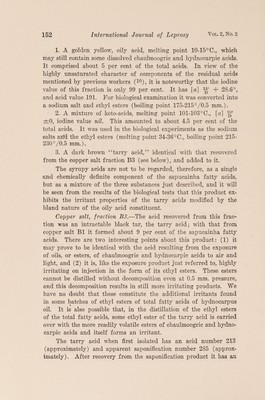
![the residual acids could not be distilled as such, or as esters, without decomposition, and it was particularly desired to avoid the risk of producing irritating substances by such methods. The total acids were divided into two parts, A and B, by crystallization from alcohol. Table 1.—Constants of sapucainha oil examined, compared with H. wightiana oiL Oil Acid value Saponifi¬ cation value Iodine value, per cent Specific rotation M D* Specific gravity at 25°C H. wightiana . Sapucainha . 6.0 21.7 196.0 199.7 95.0 101.3 + 55.4° + 54.0° 0.9656 0.9563 Fraction A.—This formed 56.5 per cent of the total acids. It had all the properties of a mixture of chaulmoogric and hydnocarpic acids ([a] 1g> + 64° to + 65°). Pure specimens of both these acids were prepared from it (chaulmoogric acid, melting point 68°, [a] + 62.05°; hydnocarpic acid, melting point 56°, [a] ^ + 67.7°). Such a mixture is a familiar product in the examination of oils of this type and does not call for further comment. In the present in¬ stance it was used for the preparation of the “ethyl esters of the crystalline acids” (boiling point 198-215°/14 mm.) for the exposure and biological tests referred to below. Fraction B.—This amounted to 43.5 per cent of the total acids and consisted of the crude residual acids. It was converted into dry sodium salts from which, after removal of unsaponifiable matter, the copper salts were precipitated by extraction, first with acetone and then with ether, into three fractions: Bl. Copper salts soluble in acetone, B2. Copper salts insoluble in acetone but soluble in ether. B3. Copper salt insoluble in acetone and ether. The acids were regenerated from these copper salt fractions and examined; that from B2 consisted of crystalline acids and was added to fraction A and need not be further considered. Copper salt, fraction Bl.—This fraction, which represented about 26 per cent of the total acids, yielded an acid mixture of much more complex composition than the B2 fraction. It contained a con¬ siderable amount of chaulmoogric and hydnocarpic acids with some palmitic acid. The remaining constituents formed a brown, oily residue referred to below as the “syrupy acids.” This, by repeated extraction, first with cold and then with hot light petroleum, was gradually resolved into three principal components.](https://iiif.wellcomecollection.org/image/b30629949_0005.jp2/full/800%2C/0/default.jpg)