The irritant constituent of anti-leprotic oils / by H. Paget, J.W. Trevan and A.M.P. Attwood.
- Paget, Humphrey.
- Date:
- [1934]
Licence: Public Domain Mark
Credit: The irritant constituent of anti-leprotic oils / by H. Paget, J.W. Trevan and A.M.P. Attwood. Source: Wellcome Collection.
6/16 page 152
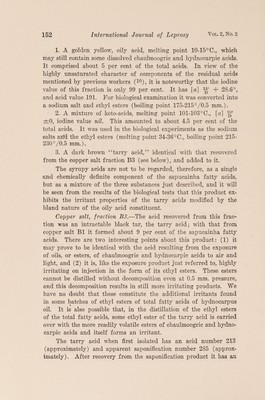
![1. A golden yellow, oily acid, melting point 10-15 °C., which may still contain some dissolved chaulmoogric and hydnocarpic acids. It comprised about 5 per cent of the total acids. In view of the highly unsaturated character of components of the residual acids mentioned by previous workers (10), it is noteworthy that the iodine value of this fraction is only 99 per cent. It has [a] -f- 28.6°, and acid value 191. For biological examination it was converted into a sodium salt and ethyl esters (boiling point 175-215°/0.5 mm.). 2. A mixture of keto-acids, melting point 101-103°C., [a] ±0, iodine value nil. This amounted to about 4.5 per cent of the total acids. It wms used in the biological experiments as the sodium salts arid the ethyl esters (melting point 34-36°C., boiling point 215- 230°/0.5 mm.). 3. A dark brown “tarry acid,” identical with that recovered from the copper salt fraction B3 (see below), and added to it. The syrupy acids are not to be regarded, therefore, as a single and chemically definite component of the sapucainha fatty acids, but as a mixture of the three substances just described, and it will be seen from the results of the biological tests that this product ex¬ hibits the irritant properties of the tarry acids modified by the bland nature of the oily acid constituent. Copper salt, fraction B3.—The acid recovered from this frac¬ tion was an intractable black tar, the tarry acid; with that from copper salt B1 it formed about 9 per cent of the sapucainha fatty acids. There are two interesting points about this product: (1) it may prove to be identical with the acid resulting from the exposure of oils, or esters, of chaulmoogric and hydnocarpic acids to air and light, and (2) it is, like the exposure product just referred to, highly irritating on injection in the form of its ethyl esters. These esters cannot be distilled without decomposition even at 0.5 mm. pressure, and this decomposition results in still more irritating products. We have no doubt that these constitute the additional irritants found in some batches of ethyl esters of total fatty acids of hydnocarpus oil. It is also possible that, in the distillation of the ethyl esters of the total fatty acids, some ethyl ester of the tarry acid is carried over with the more readily volatile esters of chaulmoogric and hydno¬ carpic acids and itself forms an irritant. The tarry acid when first isolated has an acid number 213 (approximately) and apparent saponification number 285 (approx¬ imately). After recovery from the saponification product it has an](https://iiif.wellcomecollection.org/image/b30629949_0006.jp2/full/800%2C/0/default.jpg)