Palæographia sacra. Or discourses on sacred subjects / By William Stukeley.
- William Stukeley
- Date:
- 1763
Licence: Public Domain Mark
Credit: Palæographia sacra. Or discourses on sacred subjects / By William Stukeley. Source: Wellcome Collection.
126/158 page 110
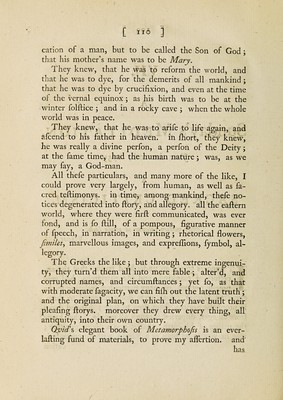
![c [ 116 ] cation of a man, but to be called the Son of God ; that his mother’s name was to be Mary. They knew, that he was to reform the world, and that he was to dye, for the demerits of all mankind; that he was to dye by crucifixion, and even at the time of the vernal equinox; as his birth was to be at the winter folftice ; and in a rocky cave ; when the whole world was in peace. They knew, that he was to arife to life again, and afcend to his father in heaven, in fhort, they knew, he was really a divine perfon, a perfon of the Deity; at the fame time, had the human nature; was, as we may fay, a God-man. All thefe particulars, and many more of the like, I could prove very largely, from human, as well as fa- cred teftimonys. in time, among mankind, thefe no¬ tices degenerated into ftory, and allegory, all the eaftern world, where they were firft communicated, was ever fond, and is fo Hill, of a pompous, figurative manner of fpeech, in narration, in writing; rhetorical flowers, ft miles, marvellous images, and expreflions, fymbol, al¬ legory. The Greeks the like; but through extreme ingenui¬ ty, they turn’d them all into mere fable; alter’d, and corrupted names, and circumftances; yet fo, as that with moderate fagacity, we can fifli out the latent truth; and the original plan, on which they have built their pleafing ftorys. moreover they drew every thing, all antiquity, into their own country. Ovid’s elegant book of Metamorphofis is an ever- lafling fund of materials, to prove my aflertion. and has](https://iiif.wellcomecollection.org/image/b30408374_0126.jp2/full/800%2C/0/default.jpg)