Principles of surgery / By N. Senn ... Illustrated with 109 wood-engravings.
- Nicholas Senn
- Date:
- 1890
Licence: Public Domain Mark
Credit: Principles of surgery / By N. Senn ... Illustrated with 109 wood-engravings. Source: Wellcome Collection.
Provider: This material has been provided by the Augustus C. Long Health Sciences Library at Columbia University and Columbia University Libraries/Information Services, through the Medical Heritage Library. The original may be consulted at the the Augustus C. Long Health Sciences Library at Columbia University and Columbia University.
26/670 page 6
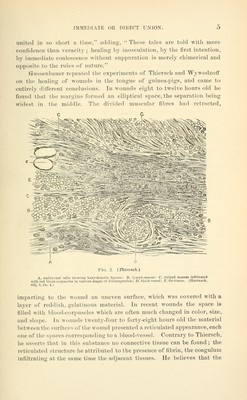
![p.ireneliymn fluid tnkes part in tlie formation of tho coagulum. He was unable to verify, by his own observations, the existence of the i)lasma channels described by Thiersch. When the wound-surfaces were kept accuratel}' approximated he found few blood-corpuscles, but the net-work of fibrin was never found absent. In hare-lip oi)erations and incised wounds of the face and scalj), if uninterru[)ted apposition is maintained I'or a day or two, the i)arts are found so firmly glued together that the belief that immediate union had taken place might still be maintained i'rom a superficial examination, but a microscopical examination will always reveal the conditions described by Gussenbauer, and the union is therefore only apparent, and nc^t real. The surfaces of the wound have become adhei'ent by the interposition of an adhesive material. A certain amount of coagulation necrosis takes place in every wound, and the material thus formed serves as a cement-substance which temporarily glues the parts together. This mechanical union, the result of destruc- tive chemical changes in tlie extravasated blood, is the form of union which has been wrongly interpreted and described as immediate union. This primar}' adhesion occurs most readily in wounds of dense vascular tissue and where approximation and fixation of the edges of the wound are most thoroughly secured,—conditions which favor the subsequent definitive healing of the wound by the interposition of new tissue. UNION BY PRIMARY INTENTION. Organic union, the union aimed at in the treatment of all wounds, is only obtained by tissue-proliferation from the fixed cells of the injured parts, and is completed only after restoration of the continuity of the divided structures, and the return, partial or complete, of the functions suspended ])y the injury or disease. Return of structure and function to an at least approximately normal standard implies a return of the interrupted circulation by the formation of new blood-vessels; in other words, organic union cannot be said to have taken place without an adequate supply of new blood-vessels in the new tissue which form a capillary net-work between the divided blood-vessels. Such a union, even under the most favorable circumstances, cannot be established in less than six to eight days, and its attainment may require weeks and months. The next method of repair described by John Hunter was union by adhesive inflammation. Absence of sui)puration and rapid union liave alwaj^s been considered as essential features of this mode of healing, and corresponds to the healing of wounds per primam inten- tionem, an expression which, for obvious reasons, has been retained in modern literature to distinguish it from the method of healing per secundem infentionem, where the reparative process is often indefinitel}''](https://iiif.wellcomecollection.org/image/b21207501_0026.jp2/full/800%2C/0/default.jpg)