Meat for millions : report of the New York State Trichinosis Commission.
- New York (State). Trichinosis Commission.
- Date:
- 1941
Licence: Public Domain Mark
Credit: Meat for millions : report of the New York State Trichinosis Commission. Source: Wellcome Collection.
15/292 (page 13)
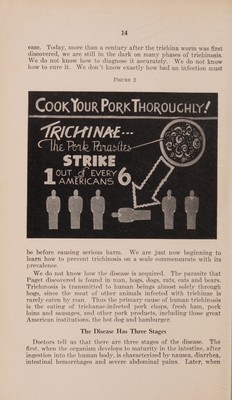
![CHAPTER III THE STORY OF TRICHINOSIS What is trichinosis? How can it be prevented? Can rt be cured? Is the disease widespread? How can rt be recognized? These are some of the questions which the people of this state have been asking since the New York State Trichinosis Commission was created. The answers to these and other questions are contained in the three articles which follow. The first two articles were written for two popular publications by the chairman of this Commission. The third article is a more technical presentation of the medical aspects of the subject. Together, these articles pave the way for a better understanding of the data contained in this report, and for a better appreciation of the significance of trichinosis as a public health problem. PORK DISEASE, A NATIONAL MENACE! By Tuomas C. DESMOND Chairman, New York State Trichinosis Commission For thirty years government officials have been warning the American people to ‘‘beware of pink pork’’ and to ‘‘eook pork thoroughly.’’ The advice has gone unheeded. Investigations by Surgeon General Parran’s white-frocked scientists indicate that the United States has the largest trichinosis problem of any nation in the world . . . that trichina, the wormlike pork parasite, infects more than 21,000,000 Americans. These facts constitute a menace and a challenge. In terms of physical consequences, they decidedly outweigh some of the more obvious national problems which make the headlines day after day. Turn back the years to 1835. In a London dissecting room, a freshman medical student named Paget, barely twenty-one years old, is peering through a pocket lens at a piece of human muscle. He sees a gray speck. Closer inspection reveals it to be a coiled worm, a parasite until then unknown to man. But Paget, destined to achieve international fame as a surgeon and pathologist, was unaware of the significance of his discovery. Trichina, the para- site that resembles a coiled hair, was looked upon merely as a zoological curiosity. Not until twenty-five years later was it estab- lished as the culprit in a painful and sometimes fatal muscle dis- 1Copyright, 1940, The American Mercury, Inc. Reprinted from The. Ameri- can Mercury, October, 1940. [13]](https://iiif.wellcomecollection.org/image/b32178244_0015.jp2/full/800%2C/0/default.jpg)