Statistical reports on the sickness, mortality, & invaliding, among the troops in Western Africa, St. Helena, the Cape of Good Hope, and the Mauritius / prepared from the records [by A.M. Tulloch, H. Marshall, and T.G. Balfour] of the Army Medical Department and War Office returns.
- Great Britain. Army Medical Services
- Date:
- 1840
Licence: Public Domain Mark
Credit: Statistical reports on the sickness, mortality, & invaliding, among the troops in Western Africa, St. Helena, the Cape of Good Hope, and the Mauritius / prepared from the records [by A.M. Tulloch, H. Marshall, and T.G. Balfour] of the Army Medical Department and War Office returns. Source: Wellcome Collection.
75/128 (page 65)
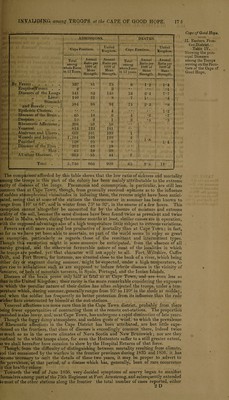
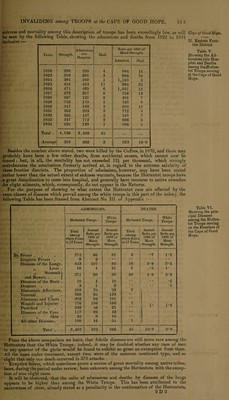
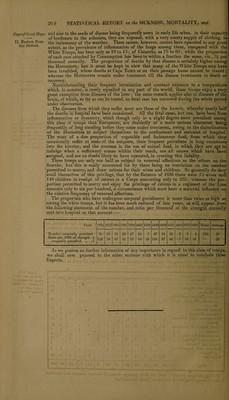
![ADMISSIONS. DEATHS. Cape Frontiers. United Kingdom. Cape Frontiers. United Kingdom. (T f H{( , , , Total Annual Annual Total Annual Animal among whole Force Ratio per Ratio per among Ratio per Ratio per 1000 of 1000 of whole Force 1000 of 1000 of in 13 Years. Mean Mean in 13 years. Mean Mean Strength. Strength. Strength. Strength. By Fevers. 537 81 75 8 1-2 1'4 Eruptive Fevers . 2 3 • • • • Diseases of the Lungs 541 82 148 16 2-4 7-7 „ Liver. 140 21 8 7 1- •4 „ Stomach 1 and Bowels . . . j 5S4 88 94 15 23 •8 Epidemic Cholera. • • • • 4 • • • • 1-2 Diseases of the Brain . 65 10 6 . 4 *6 •7 Dropsies .... 10 2 1 3 * 5 •3 Rheumatic Affections . 396 59 50 • • Venereal ,, 813 123 ] SI • • Abscesses and Ulcers . 669 101 133 1 Wounds and Injuries . 1,104 166 126 4 f 1*8 Punished . , . 168 25 8 • • 1-4 Diseases of the Eyes . 283 43 19 • • ,, Skin . 65 10 29 I • • All other Diseases. 363 55 44 j 1 7 Total 5,740 866 929 65 9-8 14* Cape of Good Hope. II. Eastern Fron¬ tier District. Table IV. Showing the prin¬ cipal Diseases among the Troops serving on the Fron¬ tiers of the Gape of Good Hope. The comparison afforded by this table shows that the low ratio of sickness and mortality among the troops in this part of the colony has been mainly attributable to the extreme rarity of diseases of the lungs. Pneumonia and consumption, in particular, are still less common than at Cape Town, though, from generally received opinions as to the influence Df sudden atmospherical vicissitudes in inducing them, the reverse might have been antici¬ pated, seeing that at some of the stations the thermometer in summer has been known to range from 110° to 64°, and in winter from 75° to 32°, in the course of a few hours. This exemption cannot altogether be accounted for by the absence of moisture and extreme iridity of the soil, because the same diseases have been found twice as prevalent and twice is fatal in Malta, where, during the summer months at least, similar causes are in operation, ivith the supposed advantage also of a high temperature little subject to extreme variations. Fevers are still more rare and less productive of mortality than at Cape Town; in fact, so far as we have yet been able to ascertain, no part of the world seems to enjoy so great in exemption, particularly as regards those of the remittent and intermittent types. Though this exemption might in some measure be anticipated, from the absence of all narshy ground, and the otherwise favourable nature of most of the localities in which die troops are posted, yet that character will not apply to all. Fort Wiltshire, Caffre Drift, and Fort Brown, for instance, are situated close to the bank of a river, which being flther dry or stagnant during summer, might be expected, under a high temperature, to rive rise to exhalations such as are supposed to induce febrile diseases in the vicinity of fumiares, or beds of mountain torrents, in Spain, Portugal, and the Ionian Islands. Diseases of the brain prove only half as fatal as at Cape Town, and are even less so than in the United Kingdom; their rarity is the more remarkable considering the exposure to which the peculiar nature of their duties has often subjected the troops, under a tem¬ perature which, during summer, generally ranges from 95° to 110° in the shade at midday, ind when the soldier has frequently no better protection from its influence than the rude svicker huts constructed by himself at the out-stations. Venereal affections are more rare than in the Cape Town district, probably from there being fewer opportunities of contracting them at the remote, out-stations. The proportion punished is also lower, and, as at Cape Town, has undergone a rapid diminution of late years. Though the foggy damp atmosphere, and sudden gusts of wind, to which the prevalence )f Rheumatic affections in the Cape District has been attributed, are but little expe¬ rienced on the frontiers, that class of diseases is exceedingly common there, indeed twice is much so as in the severe climates of Nova Scotia and New Brunswick; nor are they :onfined to the white troops alone, for even the Hottentots suffer to a still greater extent, is we shall hereafter have occasion to show by the Hospital Returns of that force. Though, from the difficulty of distinguishing between mortality resulting from climate, md that occasioned by the warfare in the frontier provinces during 1835 and 1836, it has aecome necessary to omit the details of these two years, it may be proper to advert to die prevalence, at that period, of a disease which has, generally, been ol rare occurrence n this healthy colony. Towards the end of June 1836, very decided symptoms of scurvy began to manifest fliemselves among part of the 75th Regiment at Fort Armstrong, and subsequently extended to most of the other stations along the frontier the total number of cases reported, either 2D ft](https://iiif.wellcomecollection.org/image/b30449935_0075.jp2/full/800%2C/0/default.jpg)