Descriptive catalogue of the teratological series in the Museum of the Royal College of Surgeons of England.
- Royal College of Surgeons of England. Museum
- Date:
- 1893
Licence: Public Domain Mark
Credit: Descriptive catalogue of the teratological series in the Museum of the Royal College of Surgeons of England. Source: Wellcome Collection.
Provider: This material has been provided by The University of Glasgow Library. The original may be consulted at The University of Glasgow Library.
11/226
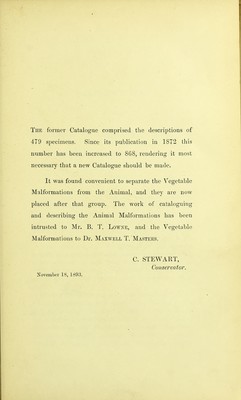
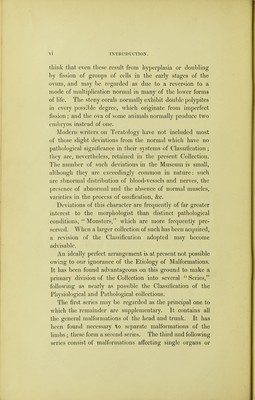
![groups of organs. This arrangement is purely artificial and anatomical, but it is the only one with our present knowledge which can be adopted without placing objects in proximity on purely theoretical grounds and separating others the comparison of which is important and is facili- tated by their juxtaposition. Such a classification has been adopted by all the leading authorities on the subject. Each Seiies is grouped in one or more Classes. Each Class consists of malformations which are similar, and which are ])robably related in their origin. The first Series contains five Classes as follows : — Class I. Situs mutatus. 11. Secondary Dichotomy. III. Double Malformations. IV. Malformations with Deficiency. V. Malformations with Distortion. In the second Series the three last Classes only occur, but it appears probable that Secondary Dichotomy, if it could be distinguished from Primary Dichotomy in its final stages, would be found to exist. The third and following Series are for the most part either too small or the malformations are too little understood to need or admit of subdivision ; others are provisionally subdivided on an anatomical basis. Two, however,—Series VII. Mal- formations of the Heart and Blood-vessels, and Series IX. Malformations of the I'rino-generative System,—are well represented and have been divided into Classes. The minor degrees of deviation from the normal are fairly represented in the first of these, and are included in a single Class, Hemiteres. The remaining malforma- tions are many of them obvious arrests, that is, they ex- hibit a permanence of a previous developmental condition. Others are so altered by adaptive modifications and sub- sequent diseases, that it is not easy or perhaps possible to](https://iiif.wellcomecollection.org/image/b21462902_0011.jp2/full/800%2C/0/default.jpg)