Miners' phthisis : reports of an investigation at Bendigo into the prevalence, nature, causes and prevention of miners' phthisis and the ventilation of the Bendigo mines / by Walter Summons ; under the direction of the Bendigo Hospital Committee and at the cost of the trustees of the Edward Wilson Estate.
- Summons, Walter.
- Date:
- 1907
Licence: In copyright
Credit: Miners' phthisis : reports of an investigation at Bendigo into the prevalence, nature, causes and prevention of miners' phthisis and the ventilation of the Bendigo mines / by Walter Summons ; under the direction of the Bendigo Hospital Committee and at the cost of the trustees of the Edward Wilson Estate. Source: Wellcome Collection.
Provider: This material has been provided by The Royal College of Surgeons of England. The original may be consulted at The Royal College of Surgeons of England.
10/118 (page 8)
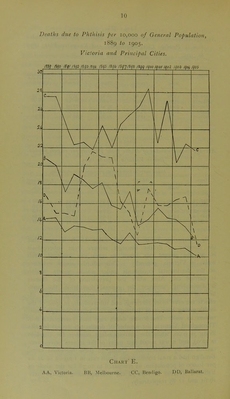
!['J'hc above figures indicate a marked increase in the nunibe.- of deaths due to pulmonary disease, more es})ecially tuljerculosis. Prior to 1880 the detrimental effects of the machine-drills had not become manifest. But, since their coming into general use,, the increase in the death rate has been progressive, and during the last ]8 months it has been so excessive that the outlook is indeed fraught with the gravest forebodings. The total number of deaths recorded as resulting from tubercu- losis of the lungs is 891, while those from chronic bronchitis amount to 280; and, as shown in the clinical notes, these, with more accuracy, should be classed as tuberculous. The two groups of cases of necessity have been considered apart. Acute pneumonia also is tabulated by itself, and, as is seen by Chart A, its prevalence shows but little variation. The total deaths from lung diseases has risen from a rate of 77-0 to one of 191-6 per 10,000, and this is largely accounted for by the increase in the tuberculous diseases, which, represented by 48-5 in the first period, now amounts to 129-6. This increase is overwhelming, and out of all proportion to the annual mortality rate from con- sumption amongst adult males. The corresponding mortality for Victoria as a whole is less in 1903-05 than at any previous time; this is clearly shown in Table III. Table IV. gives the adult male mortalit}' (miners and non-miners) for Bendigo alone. The death rate has been estimated per 10,000 living for greater convenience of comparison. There are, as a matter of fact, only 3650 miners employed at Bendigo. Unfortunately, no record is kept of the ages of the people at Bendigo, and on that account it has not been possible to deter- mine the death rates in age groups, not even in the census years. The above table, however, clearly shows the enormous increase in the deaths amongst miners from piilmonary diseases, notably tuberculosis. On the other hand, fatal mining accidents are rapidly becoming fewer in consequence of the greater precautions taken in safeguarding the life of the miner. These results can be more comprehensively seen by Charts A and B.](https://iiif.wellcomecollection.org/image/b22419810_0012.jp2/full/800%2C/0/default.jpg)