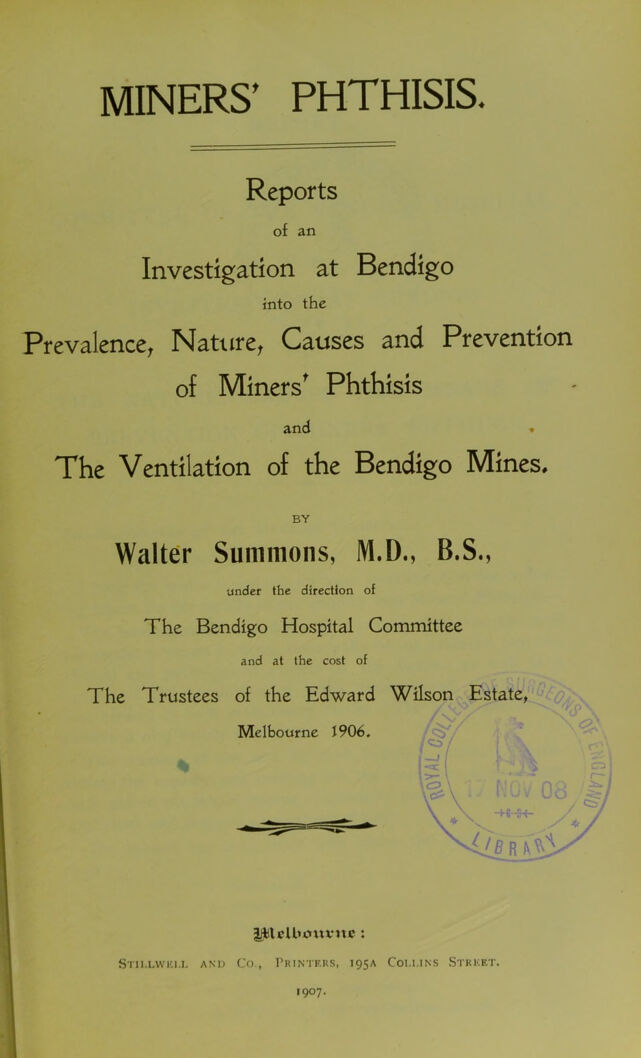
Miners' phthisis : reports of an investigation at Bendigo into the prevalence, nature, causes and prevention of miners' phthisis and the ventilation of the Bendigo mines / by Walter Summons ; under the direction of the Bendigo Hospital Committee and at the cost of the trustees of the Edward Wilson Estate.
- Summons, Walter.
- Date:
- 1907
Licence: In copyright
Credit: Miners' phthisis : reports of an investigation at Bendigo into the prevalence, nature, causes and prevention of miners' phthisis and the ventilation of the Bendigo mines / by Walter Summons ; under the direction of the Bendigo Hospital Committee and at the cost of the trustees of the Edward Wilson Estate. Source: Wellcome Collection.
Provider: This material has been provided by The Royal College of Surgeons of England. The original may be consulted at The Royal College of Surgeons of England.
106/118 page 32
![should bo iimde a puuishaljlo oll'oiico, and power sliould be vested with tlie inspeetor to inlliet a small line upon any one otl'ending. Tliore is almost the same urgent need for improvement in the matter of waste portions of “crib,” and the reeeptacles set apart for waste food should be frequently taken to the surfaee and emptied. Passing on to the vitiation of the air that ean only be removed by better ventilation, the (|uestion is raised—what standard must be adopted to insure that the mines are adequately ventilated ? A standard based on the ffuality judged by the pereentage of carbonic acid is much more satisfactory than a quantitative one, for the reasons previously given. 'I’be disadvantages of a quantity standard are obvious. Supposing the air to be pure, what need is there for a provision that 70 cubic feet of air per minute should be supplied for each man ? 'I'he standard of vitiation allowable in factories is fixed at '12 per cent, carbonic acid. Pettenkofer, who is acknowledged to be the pioneer of hygienic science, proposed ’10 per cent., for when this standard was exceeded the air began to smell unpleasantly. Coming nearer home the Royal Com- mi.ssion in VV'estern Australia, which inquii'ed into the ventilation of mines in that State, arrived at the conclusion that ’lo per cent, was the maximum allowable impurity, and that this was a fair and easily maintained practical limit. As before shown, the carbonic acid present in the Bendigo mines, though not altogether due to impurity from respiration, results from other causes which are as harmful. For ventilation purposes the amount may thus be con- sidered as the “ respiratory impurity,” and the standard adopted should not difi'er in any way from that required for factories. Though T2 per cent, is the standard generally taken, in cotton-cloth factories, in which it is desirable to have a moist atmosphere to facilitate the manufacture of the goods, a higher standard is adopted, and the law limits the amount of carbonic acid gas to '09 per cent. In the mines we have a warm, humid atmosphere, vitiated in more ways than that of surface buildings, containing a large amount of dust and products from combustion of explosives. It would not be asking too much if the miners were provided with the same quality of air as is insisted on in factories. However, a maximum can only be adopted that is attainable at reasonable cost. Under similar conditions in Western Australia T5 per cent, was chosen as a satisfactory standard, and there is no reason for adopting a lower standard for the mines of Bendigo. The present Mines Act makes no distinction between mines in which a large amount of carbonic acid is derived from the rock and others where this amount is negligible, but with regard to the quality of the air states—“ Ibe amount of carbonic anhydride in the air in any working places of the mine or in the approaches thereto shall not exceed three parts by volume in 1,0(K), and the amount of oxygen in the air in such working places or the approaches thereto shall not be less than twenty per centum by volume.” The New South Wales Act, on the other hand, requires that the 00^ shall not exceed ■! per cent., as well as saying that the supply of pure air be of not le.ss quantity than 100 cubic feet per minute for each worker. Ado])ting a quality standard, which is certainly a more rational one, the quantity of air is immaterial. Moreover, in a large ojren stope there may be a current sufficient tf> fullil the law’s requirements, but it moves so slowly that even the most delicate anemometer for practical ob.servations may not give a true record, whereas when the stupe narrows to a drive again there would be a strong current of air. I would therefore propose that 'IS per cent.](https://iiif.wellcomecollection.org/image/b22419810_0108.jp2/full/800%2C/0/default.jpg)


 No text description is available for this image
 No text description is available for this image
 No text description is available for this image