Medical education, medical colleges and the regulation of the practice of medicine in the United States and Canada, 1765-1891 : Medical education and the regulation of the practice of medicine in foreign countries.
- John Henry Rauch
- Date:
- 1891
Licence: Public Domain Mark
Credit: Medical education, medical colleges and the regulation of the practice of medicine in the United States and Canada, 1765-1891 : Medical education and the regulation of the practice of medicine in foreign countries. Source: Wellcome Collection.
Provider: This material has been provided by The University of Leeds Library. The original may be consulted at The University of Leeds Library.
11/262
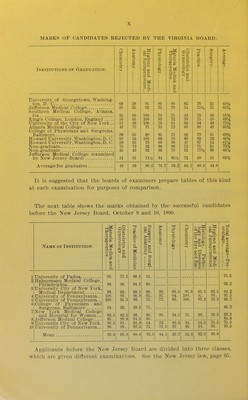
![The work of the boards may be facilitated in doubtful cases if they will refer to the pages of this Keport for the status of the colleges represented by applicants. It is a matter of importance that the work of these examining boards should be as uniform as possible, in order to bring about the best results so far as medical education and the regulation of the practice of medicine are concerned. The difficulties incident to divided and limited jurisdic- tions would thus be overcome, and the work made broader and more na- tional in its character. Unless this is done, owing to the frequent changes of residence by medical men, repeated examinations become onerous, and in some cases work hardship. This is one of many good reasons for try- ing to secure cooperation and uniformity of action in issuing and recog- nizing certificates of examination by the various boards. If this course is adopted, it will furnish facilities for the investigation of the character of applicants when removing to other states, as experi- ence has taught that graduates having diplomas from some of the best medical colleges, or those who have passed a good examination, occas- ionally become the greatest professional frauds. Knowledge of the his- tory of these men, thus obtained, would assist in preventing their being licensed in other states, and would exercise a supervision over all, which would do much towards upholding the morale of the profession. The laws under which these boards work are different in some respects, and the conditions of examination differ. In the case of at least twenty schools the results of the examinations give too much or too little credit in the talDle. Some of the applicants are recent graduates,' and others have been in practice for some time. It has been the practice of this Board to recognize the certificates of examination issued by other Boards. The following tables are interesting: Standing in each Section of the Applicants Rejected September 3d and 4th, 1890, BY THE MeDICAL EXAMINING BOARD OF VIRGINIA, AND THE Colleges from which they Received Diplomas. The standard of requirements for license is an average mark of T5 per cent, on the whole. If, however, an applicant receives less than 33i per cent, in any one of the eight Sections, he is rejected. [-This Table is introduced solely for the purpose of indicating the branches of study in which the greatest deficiencies of preparation of the applicants are most noticeable. In addition, it should be remarked that had It been required to rate the applicants on ordinary correctness of i<.nglish grammar, at least one-third of those who passed satisfactory ex- aminations on the required branches of medical study would have received very low marltings, and far more than one-half of those rejected showed in their examination papers, lamentable ignorance of English composition spelling, etc.—Secretary of the Virginia board.]](https://iiif.wellcomecollection.org/image/b21508070_0011.jp2/full/800%2C/0/default.jpg)


 No text description is available for this image
 No text description is available for this image
 No text description is available for this image