Essentials of legal medicine, toxicology and hygiene : with 130 illustrations / by C.E. Armand Semple.
- Semple, C. E. Armand (Charles Edward Armand), 1845-1895
- Date:
- 1895
Licence: Public Domain Mark
Credit: Essentials of legal medicine, toxicology and hygiene : with 130 illustrations / by C.E. Armand Semple. Source: Wellcome Collection.
Provider: This material has been provided by the Harvey Cushing/John Hay Whitney Medical Library at Yale University, through the Medical Heritage Library. The original may be consulted at the Harvey Cushing/John Hay Whitney Medical Library at Yale University.
198/254 (page 176)
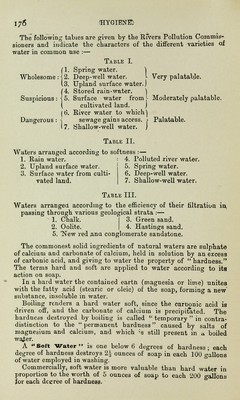
![The following tables are given by the Rivers Pollution Commis- sioners and indicate the characters of the different varieties of water in common use :— Table I. (1. Spring water. \ Wholesome : \ 2. Deep-well water. I 13. Upland surface water.) '4. Stored rain-water. \ 5. Surface water from '■ cultivated land. J (6. River water to which] Dangerous : -j sewage gains access, t I 7. Shallow-well water, j Table II. Suspicious: Very palatable. Moderately palatable. Palatable. Waters arranged according to softness :— 1. Rainwater. i 4. Polluted river water. 2. Upland surface water. 5. Spring water. 3. Surface water from culti- 6. vated land. 7. Deep-well water. Shallow-well water. Table III. Waters arranged according to the efficiency of their filtration in, passing through various geological strata :— 1. Chalk. I 3. Green sand. 2. Oolite. I 4. Hastings sand. 5. New red ,ana conglomerate sandstone. The commonest solid ingredients of natural waters are sulphate of calcium and carbonate of calcium, held in solution by an excess of carbonic acid, and giving to water the property of hardness. The terms hard and soft are applied to water according to its action on soap. In a hard water the contained earth (magnesia or lime) unites with the fatty acid (stearic or oleic) of the aoap, forming a new substance, insoluble in water. Boiling renders a hard water soft, since the carbonic acid is driven off, and the carbonate of calcium is precipitated. The hardness destroyed by boiling is called temporary in contra- distinction to the permanent hardness caused by salts of magnesium and calcium, and which ;s still present in a boiled wa^er. A Soft Water is one below 6 degrees of hardness; each degree of hardness destroys 2\ ounces of soap in each 100 gallons of water employed in washing. Commercially, soft water is more valuable than hard water in proportion to the worth of 5 ounces of soap to each 200 gallons for each decree of hardness.](https://iiif.wellcomecollection.org/image/b21004237_0198.jp2/full/800%2C/0/default.jpg)