A text-book of horseshoeing for horseshoers and veterinarians / by A. Lungwitz, translated from the 10th German edition by John W. Adams.
- Friedrich Clemens Anton Lungwitz
- Date:
- 1904
Licence: In copyright
Credit: A text-book of horseshoeing for horseshoers and veterinarians / by A. Lungwitz, translated from the 10th German edition by John W. Adams. Source: Wellcome Collection.
164/188 page 160
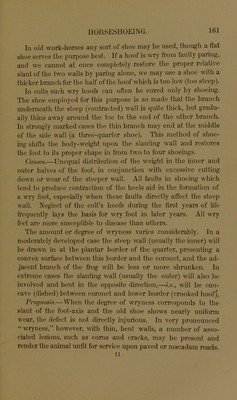
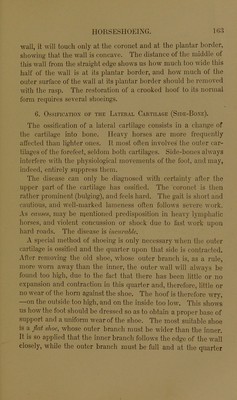
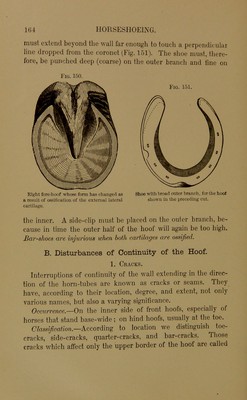
![The treatment is correspondingly simple: flat shoes with per- fecily horizontal bearing-surface, and in very strongly marked cases Clips at the ends of the branches (buttress clips). In all forms of contraction of the hoof abundant exercise and the maintenance of the natural pliancy of the horn by daily moistening (washing) with water are ahsolutely necessary for successful treat- nient. 4. The Wry Hoof. If one side wall and quarter is steep, and the other very slant- ing or oblique, we term such a hoof a “ wry hoof.” Such a hoof divided in the middle line presents two very dissimilar halves. There are three classes of wry hoofs: 1, normal wry hoofs (see page 69); 2, pathological wry hoofs, or hoofs con- tracted in one quarter (see contracted hoofs); 3, wry hoofs which are the result of improper shortening of the wall and of neglect in horses running barefoot. Only the second and third classes of wry hoofs require es- pecial attention. First, the more ob- lique wall must be cut down, and the steep wall spared,—a procedure which differs essentially from that employed in treating the first dass, but is, never- theless, entirely warranted, because these second and third kinds of wry hoofs do not correspond to the direc- tion of the limb. In Order to take weight from the steep wall, we use with advantage a har-shoe, wdiich should be longer and wider than the hoof on its contracted side. In other words, enlarge the base of support by making the brauch of the shoe broader. If the whole outside wall is contracted the outer branch of the shoe must be broad, the bor- der bevelled base-wide, and the branch punched so deeply that the nail-holes will fall upon the white line. Fig. ]48. A pathologically wry left hind hoof. The'outer branch of the shoe, which is broader than the inner, should have a base-wide border and project far enough to support the Coronet.](https://iiif.wellcomecollection.org/image/b28127559_0164.jp2/full/800%2C/0/default.jpg)
 No text description is available for this image
 No text description is available for this image
 No text description is available for this image