An elementary compendium of physiology : for the use of students / by F. Magendie ; translated from the French with copious notes, tables, and illustrations, by E. Milligan.
- Magendie, François, 1783-1855. Précis élémentaire de physiologie. English
- Date:
- 1829
Licence: Public Domain Mark
Credit: An elementary compendium of physiology : for the use of students / by F. Magendie ; translated from the French with copious notes, tables, and illustrations, by E. Milligan. Source: Wellcome Collection.
Provider: This material has been provided by University of Bristol Library. The original may be consulted at University of Bristol Library.
599/710 (page 547)
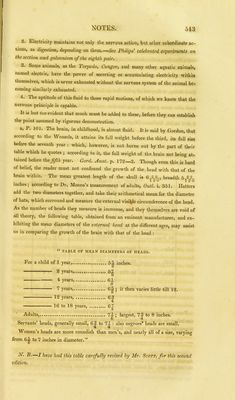
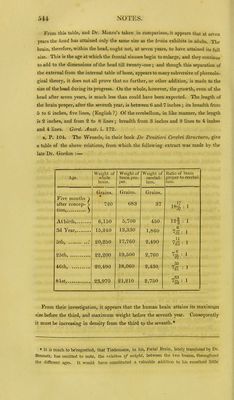
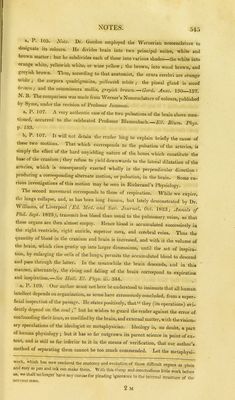
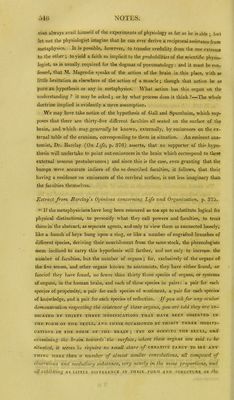
![54-7 convolutions of the intestine : nay all, when unfolded, according to Spurzheim, in cases of hydrocephalus internus, presenting but one uniform web of cineri. tious and medullary matter. No phrenologist has ever yet observed the supposed lines of distinction between them; and no phrenologist, therefore, has ventured, m the course of his dissections, to divide a hemisphere of the brain accurately into any such number of well marked and specific organs. But suppose it divided, and each organ or system of organs to be presented to another professed adept in the seieuce, would he venture, were they presented promiscuously, to distinguish, merely by their form and structure, au organ of one propensity from another ; au organ of propensity from an organ of sentiment, an organ of sentiment from an organ of knowledge, or an organ of knowledge from an organ of reflection. He would be a hardy phrenologist if he did, as these organs are not distinguishable by any characteristic appearances, like the organs of sense. “ °n Seelg an ear’ an e>’e> a nostl i]. a hand, a tongue, no anatomist requires to be informed what these are, where they were situated, or how they were connected, to be able to say in what functions it had been employed : their .narked peculiarities speak for themselves. No such dilferences appear among the organs assigned to the brain ; aud perhaps this circumstance may be adduced as one of the reasons why these organs have remained in concealment for so many ages; and yet this reason SCarCe'y admissible, considering, especially, that these organs are never found at the base of the cranium, nor in any place where they cannot at all times be easily seen; nay, it appears that they so affect conspicuous situations, and so prone are they to obtrude themselves on the notice of the senses, that there is not any visible part on the crown of the head, on the frontal bone, on the occiput, or the tern- pies, where, according to phrenologists, they do not exhibit, even through the hardest and the thickest skulls, undeniable proofs of their actual presence. Is it then in order to be always within the sphere of physiognomic and phrenological mvest.gat.on, that they equally avoid the central parts of the cerebral substance ? ^ut, if always thus confined to the surface and to the convolutions, for the sake of being seen, what becomes of the corpus callosum, the septum lucidum, the fornix, the infundibulum, the two commissures, the corpora striata, the corpora quadrige- mina, the pineal gland, the cornua ammonis, and the/our ventricles? Are these to be excluded from the number of organs, and not to be permitted to have any influence on the propensities, on the sentiments, the species of knowledge, or the species of reflection ? Are they to be viewed merely as a part of the common stock on which the specific organs are engrafted, and through which they are connected ?” The phrenologists, however, now very properly appeal from anatomy and physiolo- gy, to lacts ; for these must ultimately establish or overthrow the credit of their doc- trine—Every one, of course, will judge for himself in this way : as far as my own experience has gone, it lias been entirely unfavourable to craniology,— and my trials have both been numerous, and made on persons whose internal faculties were strongly developed. Indeed, though phrenology places all the finer and more exalted faculties of our nature in some region or other of the forehead, 1 have repeat-](https://iiif.wellcomecollection.org/image/b21439709_0599.jp2/full/800%2C/0/default.jpg)