An elementary compendium of physiology : for the use of students / by F. Magendie ; translated from the French with copious notes, tables, and illustrations, by E. Milligan.
- Magendie, François, 1783-1855. Précis élémentaire de physiologie. English
- Date:
- 1829
Licence: Public Domain Mark
Credit: An elementary compendium of physiology : for the use of students / by F. Magendie ; translated from the French with copious notes, tables, and illustrations, by E. Milligan. Source: Wellcome Collection.
Provider: This material has been provided by University of Bristol Library. The original may be consulted at University of Bristol Library.
622/710 (page 570)
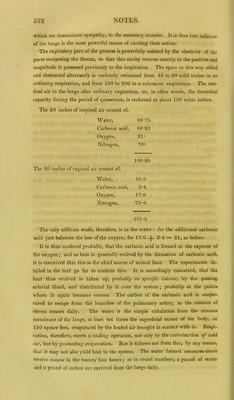
![respiration to its exciting cause, may also be considered susceptible of these three denominations. . Thus Natural respiration may be considered either as mechanical, chemical, or vital. 1. The mechanism of natural inspiration is performed by, a, The contraction of the intercostal muscles ; which raises the ribs upwards, projects their plane outwards, and throws the sternum forwards, augmenting the transverse diameter of the thorax two lines, and its depth from spine to sternum, as much. b, The contraction of the diaphragm ; by which either the centre of that organ descends perpendicularly, or a large segment of its dome becomes conical. In either example the thoracic cavity becomes enlarged; but five times as much by the latter, b, as by the former, a : so that if the whole augmentation is 20 inches, a contributes 4, b 16 solid inches. 2. Natural expiration is performed by, c, The abdominal muscles. d, The elasticity of the ribs, cartilages, muscles, and integuments of thorax. e, The elasticity of mediastinum. f, The protrusion of the bowels upwards in the dome of the diaphragm. g, The contraction of the parenchyma, ligaments, cartilages, membranes, and bronchial muscles of the lungs themselves. h, The weight of the parts; and,' as some think, the pressure of the atmosphere. These forces are divided into the living or muscular forces; and the dead, or mechanical forces, resulting from elasticity or gravity. It is probable, that as either of the two causes of inspiration may produce that action alone, so either of the two classes of causss of expiration may produce the latter alone. The ascent of the diaphragm takes away about four-fifths of the whole inspiratory increment from the cavity of the thorax, but it is impossible to say whether the living or the dead forces contribute most to this effect; for it seems to take place readily in pregnancy, and diseases, in which the muscular contraction, or living force, must be extremely small. This, however, in natural expiration, seems the act of the abdominal muscles alone. Vehement, or willed inspiration, superadds to the above named agents the voluntary muscles which fix the neck and pelvis, and connect the thorax with these two adjoining regions. Thus the muscles of vehement inspiration are, Dia]>hragma Cervicales descendentcs Intercostales Platysmata myoidea Sterno-hyoideus Pectorales majores Stcrno-tliyroideus Pectorales ininores Scaleni Serrati magni nntici Levatores scapuke Levatores eostarum Albini Subclavii Serrati postici superiores.](https://iiif.wellcomecollection.org/image/b21439709_0622.jp2/full/800%2C/0/default.jpg)