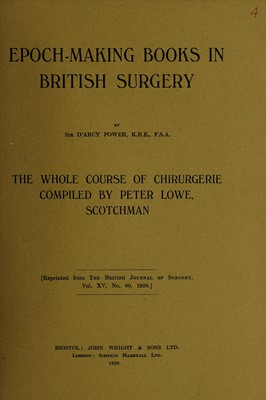
Epoch-making books in British surgery. IV, The whole course of chirurgerie compiled by Peter Lowe, Scotchman / by Sir D'Arcy Power, K.B.E., F.S.A.
- D'Arcy Power
- Date:
- 1928
Licence: In copyright
Credit: Epoch-making books in British surgery. IV, The whole course of chirurgerie compiled by Peter Lowe, Scotchman / by Sir D'Arcy Power, K.B.E., F.S.A. Source: Wellcome Collection.
6/14 (page 534)
![and his son John in the second and subsequent editions ; partly a series of more elaborated chapters, some of which give details of his own experiences. We learn from the book that most of his surgery was the result of military service, that it was not very extensive, and that he was somewhat timid. He was an honest, straightforward person who had as hearty a hatred of quacks and unlicensed practitioners as Gale and Clowes. Thus, in answer to the question, “ What method is to be observed of the Chirurgian in working his operations ? ” the answer is, “ First to know the disease, next to do the opera¬ tion as soon as may.be, surely, without false promises or deceit to heal things that cannot be healed, for there are some, who void of knowledge and skill promise for lucre to heal infirmities being ignorant both of the disease and the remedies thereof. These faults be often committed of some who, usurping the name of Chirurgian, being unworthy thereof, have scarce the skill to cut a beard which properly pertaineth to their trade.” There are many interesting chapters, and not the least is that dealing with the tonsils. It is headed, “ Of the Tumor of the Amigdalles, called by the Greeks Parischimia and by Latines Tonsilke ”, in which the operation of tracheotomy is described. After detailing the symptoms and constitutional treatment he says: “If it apostliume [suppurates], as often happeneth, it must be opened with a lancet, if the tumor doth so augment that the sick is in danger to suffocke then thou shalt make incision on the trachearter, betwixt the third and fourth ring, cutting only the membrane that holdeth them together and not the proper substance of the cartilage, so the air shall avoid [escape], put in a tent of silver that is hollow into it till the inflammation be past, thereafter close up the wound. This was practised by Andrew Scot one of the King of Scotland’s Chirurgions in Paris most cunningly. To do this operation thou shalt hold backward the patient’s head, lift up the skin with the hand and cut it in length, so the membrane shall be discovered, then make your incision with a bistourie in the said place; during which time, use externally, medicaments about the neck that are made of barley flour, lint seed and fenegrec as shall be found most expedient according to the degree of the malady. This operation of incision is very dangerous if it be not well made by reason of the flux of blood which often doth happen as also for the nerves which pass that way. I cured an apothecary in Paris after this method and he healed.” Speaking of pleurisy he says : “ If by these remedies the pain doth not cease, neither that ye perceive any evacuation of the humour, neither by the mouth, urine, nor fundament it is to be suspected to turn into Empiem which is a collection of matter between the ribs and the region of the lights, some¬ time with corruption hereof, for the which we make incision either by cautery or lancet but rather by the cautery, for neither doth it close so soon, nor is so dolorous. The opening shall be between the third and fourth of the true ribs, beginning at the nethermost and so counting upward, six inches from the ridge of the back. If ye see tumour eminent in any place of the thorax, open it in the most convenient place. When it is open put in a hollow tent either of silver or lead. Let not all the matter avoid at one time, but little by little as other apostumes.” Ten years later he adds in the second edition : “ This cure is rare and seldom practised, yet after this method I did cure John](https://iiif.wellcomecollection.org/image/b3080128x_0006.jp2/full/800%2C/0/default.jpg)