Licence: Public Domain Mark
Credit: Jerome Cardan : a biographical study. Source: Wellcome Collection.
Provider: This material has been provided by the Gerstein Science Information Centre at the University of Toronto, through the Medical Heritage Library. The original may be consulted at the Gerstein Science Information Centre, University of Toronto.
282/328 page 264
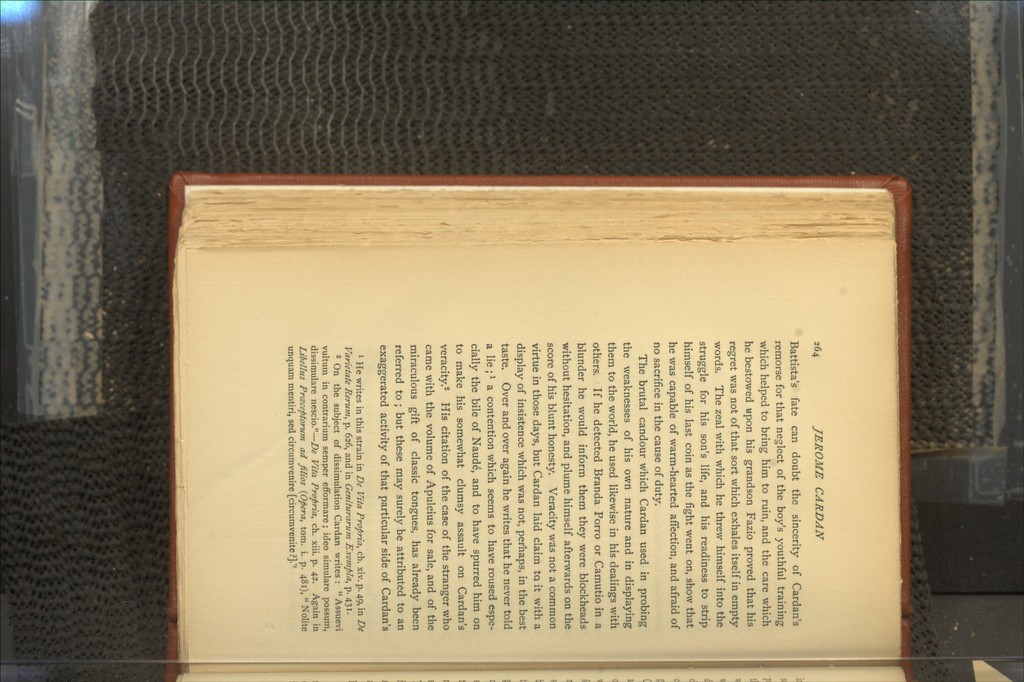
![Battista's fate can doubt the sincerity of Cardan's remorse for that neglect of the boy's youthful training which helped to bring him to ruin, and the care which he bestowed upon his grandson Fazio proved that his regret was not of that sort which exhales itself in empty words. The zeal with which he threw himself into the struggle for his son's life, and his readiness to strip himself of his last coin as the fight went on, show that he was capable of warm-hearted affection, and afraid of no sacrifice in the cause of duty. The brutal candour Which Cardan used in probing the weaknesses of his owri nature and in displaying them to the world, he used likewise in his dealings with others. If he detected Branda Porro or Camutio in a blunder he would inform them they were blockheads without hesitation, and plume himself afterwards on the score of his blunt honesty. Veracity was not a common virtue in those days, but Cardan laid claim to it with a display of insistence which was not, perhaps, in the best taste. Over and over again he writes that he never told a lie;J a contention which seems to have roused espe- cially the bile of Naud6, and to have spurred him on to make his somewhat clumsy assault on Cardan's veracity.2 His citation of the case of the stranger who came with the volume of Apuleius for sale, and of the miraculous gift of classic tongues, has already been referred to ; but these may surely be attributed to an exaggerated activity of that particular side of Cardan's 1 He writes in this strain in De Vita Propria, ch. xiv. p. 49, in De Varietate Rerum, p. 626, and in Geniturarum Exempla, p. 431. 2 On the subject of dissimulation Cardan writes : Assuevi vultum in contrarium semper eflformare; ideo simulare possum, dissimulare nescio.—De Vita Propria, ch. xiii. p. 42. Again in Libellus Praceptorum ad filios (Opera, torn. i. p. 481), Nolite unquam mentiri, sed circumvenire [circumvenite ?].''](https://iiif.wellcomecollection.org/image/b20996160_0282.jp2/full/800%2C/0/default.jpg)
 No text description is available for this image
 No text description is available for this image
 No text description is available for this image