On dissecting aneurysm of the aorta / by T.N. Kelynack.
- Theophilus Kelynack
- Date:
- 1898
Licence: Public Domain Mark
Credit: On dissecting aneurysm of the aorta / by T.N. Kelynack. Source: Wellcome Collection.
Provider: This material has been provided by The Royal College of Surgeons of England. The original may be consulted at The Royal College of Surgeons of England.
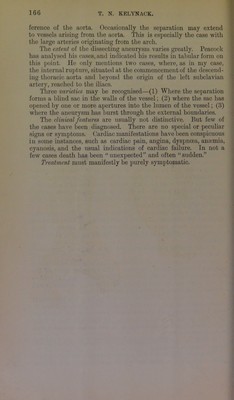
8/14 page 166
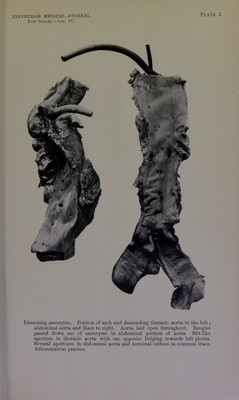
![ference of the aorta. Occasionally the separation may extend to vessels arising from the aorta. This is especially the case with the large arteries originating from the arch. The extent of the dissecting aneurysm varies greatly. Peacock has analysed liis cases, and indicated his results in tabular form on this point. He only mentions two cases, where, as in my case, tlie internal ru])ture, situated at the commencement of the descend- ing thoracic aorta and beyond the origin of the left subclavian artery, reached to the iliacs. Three varieties may be recognised—(1) Where the separation forms a blind sac in the walls of the vessel; (2) where the sac has opened by one or more apertures into the lumen of the vessel; (3) where the aneurysm has burst through the external boundaries. The clinical features are usually not distinctive. But few of the cases have been diagnosed. There are no special or peculiar signs or symptoms. Cardiac manifestations have been conspicuous in some instances, such as cardiac pain, angina, dyspnoea, aniemia, cyanosis, and the usual indications of cardiac failure. In not a few cases death has been “ unexpected” and often “ sudden.” Treatment must manifestly be purely symptomatic.](https://iiif.wellcomecollection.org/image/b2233547x_0010.jp2/full/800%2C/0/default.jpg)