Immune sera : a concise exposition of our present knowledge concerning the constitution and mode of action of antitoxins, agglutinins, hæmolysins, bacteriolysins, precipitins, cytotoxins, and opsonins / by Dr. Charles Frederick Bolduan.
- Charles Bolduan
- Date:
- 1908
Licence: In copyright
Credit: Immune sera : a concise exposition of our present knowledge concerning the constitution and mode of action of antitoxins, agglutinins, hæmolysins, bacteriolysins, precipitins, cytotoxins, and opsonins / by Dr. Charles Frederick Bolduan. Source: Wellcome Collection.
42/218 page 26
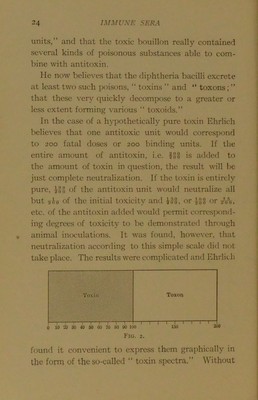
![that one fatal dose is set free. This relation would exist right to the end. The fact that in this experi- ment the toxins are liberated after the toxons, shows that the toxons have less affinity for the anti- toxin than have the toxins. As a matter of fact, however, conditions are prob- ably never as simple as this. In the process of toxin formation a double action is always going on — that of toxin and toxon production, and that of their decomposition. As was pointed out on a previous page the ])oisons quickly change into non-poisonous toxoids, and these substances are still able to bind antitoxin. This is shown in the following “ spectrum.” Here we would obtain the following figures: .T®® poison + §0 0 antitoxin unit = o, i.e. abso- lutely neutral. a:®® poison + boo = Toxon free. a:®® poison -t- = Toxon free, rt®® poison + = Toxin free (i fatal dose.) 2;®® poison + i88 = Toxin free (60 fatal doses.) poison 4- aVo' == Toxin free (100 fatal doses.)](https://iiif.wellcomecollection.org/image/b28060167_0042.jp2/full/800%2C/0/default.jpg)