Licence: Public Domain Mark
Credit: A treatise on the continued fevers of Great Britain. Source: Wellcome Collection.
Provider: This material has been provided by the Augustus C. Long Health Sciences Library at Columbia University and Columbia University Libraries/Information Services, through the Medical Heritage Library. The original may be consulted at the the Augustus C. Long Health Sciences Library at Columbia University and Columbia University.
29/814 (page 3)
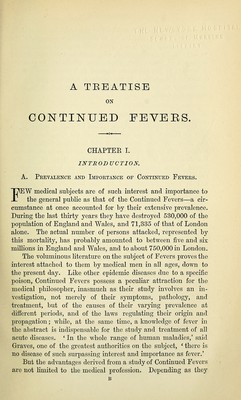
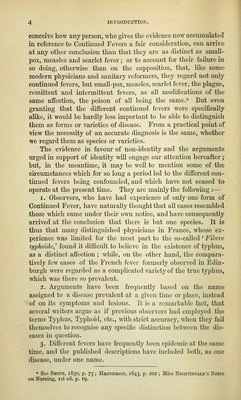
![ihat of the specific identity or non-identity of the different forms of continued fever. But now the question may be regarded as finally settled. The investigations of Henderson and other writers on the epidemic of 1843 established the specific distinct- ness of relapsing fever from typhus, while those of Gerhard, Stewart, Jenner, and others have proved the non-identity of the irue typhus and the ' typhoid fever,' so ably described by Louis. These three diseases, then, are all included under the generic term ' Continued Fevers,' as likewise a fourth, which may be ■styled Simple Fever. The three former owe their origin to poisons which are as distinct as those of Measles, Scarlet Fever, ■and Small-Pox; Simple Fever arises from non-specific causes, such as exposure to heat, nervous exhaustion, etc. Another ■circumstance worthy of notice is, that of the three specific fevers, two (typhus and relapsing, but particularly the latter) prevaO, for the most part, as great epidemics ; whereas the third (enteric) is ;an endemic disease. According to our present knowledge, the continued fevers of Britain may be classified as follows :— A.—Non-specific. I. Simple Fever, caused by . i Exposure to sun, t^ ' ( latigue, surfeit, etc. /Poison contained in II. Endemic (Enteric, Typhoid, or] drinking -water, Pythogenic) . . . . ] emanations from y sewers, etc. B.—SpEcmc.-i /Contagion, or the ,m 1 J concentrated ex- Typhus caused J t^i^tions from III. & IV. Epidemic ^^ ' [ ggt! ^'''''' vEelapsing Fever. Contagion or Famine. The plurality of Continued Fevers is now generally admitted and is advocated in this work. It is true that there are still some distinguished members of the profession, who believe that the fevers above mentioned are mere varieties and all spring from one poison. But the opinions of great authorities must not be allowed to bias the mind and make it misinterpret the facts of nature. It must not be forgotten that among our forefathers were men characterised by genius and powers of observation equal to those possessed by any living physicians, who regarded variola, measles and scarlet fever, as all modifications of one disease—different effects of the same poison, although their own recorded descriptions prove that the diseases they saw were as different as they are now. It is, in my opinion, difficult to B 2](https://iiif.wellcomecollection.org/image/b2121220x_0029.jp2/full/800%2C/0/default.jpg)