Alcohol and the human body : an introduction to the study of the subject / by Victor Horsley and Mary D. Sturge ; with a chapter by Arthur Newsholme.
- Victor Horsley
- Date:
- 1907
Licence: In copyright
Credit: Alcohol and the human body : an introduction to the study of the subject / by Victor Horsley and Mary D. Sturge ; with a chapter by Arthur Newsholme. Source: Wellcome Collection.
Provider: This material has been provided by The University of Leeds Library. The original may be consulted at The University of Leeds Library.
13/458
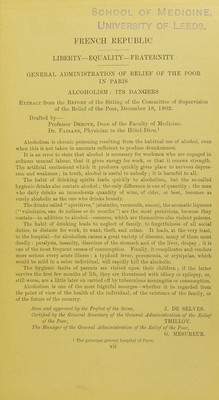
![University of 1/ FRENCH REPUBLIC LIBERTY—EQUALITY—FEATERNITY GENERAL ADMINISTEATION OF RELIEF OF THE POOR IN PARIS ALCOHOLISM: ITS DANGERS Extract from the Report of the Sitting of tlie Committee of Supervision of the Relief of the Poor, December 18, 1902. Drafted by— Professor Debove, Dean of the Faculty of Medicine. Dr. Faisans, Physician to the Hotel-Dieu.^ Alcoholism is chronic poisoning resulting from the habitual use of alcohol, even when this is not taken in amounts sufficient to produce drunkenness. It is an error to state that alcohol is necessary for workmen who are engaged in arduous manual labour, that it gives energy for work, or that it renews strength. The artificial excitement which it produces quickly gives place to nervous depres- sion and weakness ; in truth, alcohol is useful to nobody ; it is harmful to all. The habit of drinking spirits leads quickly to alcoholism, but the so-called hygienic drinks also contain alcohol; the only difference is one of quantity ; the man who daily drinks an immoderate quantity of wine, of cider, or beer, becomes as surely alcoholic as the one who drinks brandy. The drinks called aperitives, (absinthe, vermouth, amers), the aromatic liqueurs ( vulneraire, eau de mi^lisse or de nienthe) are the most pernicious, because they contain—in addition to alcohol—essences, which are themselves also violent poisons. The habit of drinking leads to neglect of family, to forgetfulness of all social duties, to distaste for work, to want, theft, and crime. It leads, at the very least, to the hospital—for alcoholism causes a great variety of diseases, many of them most deadly : paralysis, insanity, disorders of the stomach and of the liver, dropsy ; it is one of the most frequeut causes of consumption. Finally, it complicates and renders more sei'ious every acute illness ; a typhoid fever, pneumonia, or erysipelas, which would be mild in a sober individual, will i-apidly kill the alcoholic. The hygienic faults of pareuts are visited upon their children ; if the latter survive the first few months of life, they are threatened with idiocy or epilepsy, or, still worse, are a little later on carried off by tuberculous meningitis or consumption. Alcoholism is one of the most frightful scourges—whetlier it be regarded from the point of view of the health of the individual, of the existence of the family, or of the future of the country. Seen and approved by the Prefect of tlie Seine, 3. DE SELVES. Certified by the General Secretary of the General Administration of tlie Relief of the Poor, THILLOY. The Ma/iutger of the General Administration of the Relief of the Poor, G. MESUREUR. 1 Tlie priiiRipal gnnpral lio.s])it;il of Paris.](https://iiif.wellcomecollection.org/image/b21535450_0013.jp2/full/800%2C/0/default.jpg)