Volume 2
Universal palaeography, or, Fac-similes of writings of all nations and periods, copied from the most celebrated and authentic manuscripts in the libraries and archives of France, Italy, Germany, and England / by M.J.B. Silvestre ; accompanied by an historical and descriptive text and introduction by Champollion-Figeac and Aimé Champollion, fils ; translated from the French and edited, with corrections and notes, by Sir Frederic Maddan ... in two volumes.
- Joseph-Balthazar Silvestre
- Date:
- 1849-1850
Licence: Public Domain Mark
Credit: Universal palaeography, or, Fac-similes of writings of all nations and periods, copied from the most celebrated and authentic manuscripts in the libraries and archives of France, Italy, Germany, and England / by M.J.B. Silvestre ; accompanied by an historical and descriptive text and introduction by Champollion-Figeac and Aimé Champollion, fils ; translated from the French and edited, with corrections and notes, by Sir Frederic Maddan ... in two volumes. Source: Wellcome Collection.
156/458 page 514
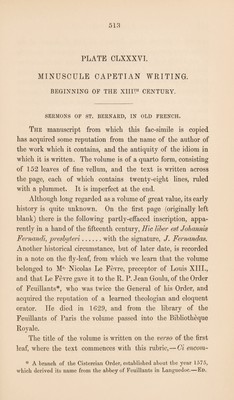
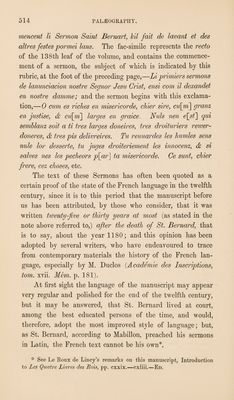
![mencent li Sermon Saint Bernart, hit fait de lavant et des altres festes pormei Ians. The fac-simile represents the recto of the 138th leaf of the volume, and contains the commence¬ ment of a sermon, the subject of which is indicated by this rubric, at the foot of the preceding page,—Li primiers sermons de lanunciacion nostre Segnor Jesu Crist, ensi com il dexandet en nostre damme; and the sermon begins with this exclama¬ tion,— 0 cum es riches en misericorde, chier sire, cu\m\ granz en justise, d cu[ni\ larges en graice. Nuls nen e[st] qui semblanz soit a ti tres larges doneires, tres droituriers rewer- doneres, d tres pis delivreires. Tu reuuardes les humles sens nule lor desserte, tu juges droiteriement les innocenz, d si salves nes les pecheors p[ar] ta misericorde. Ce sunt, chier frere, cez choses, etc. The text of these Sermons has often been quoted as a certain proof of the state of the French language in the twelfth century, since it is to this period that the manuscript before us has been attributed, by those who consider, that it was written twenty-five or thirty years at most (as stated in the note above referred to,) after the death of St. Bernard, that is to say, about the year 1180; and this opinion has been adopted by several writers, who have endeavoured to trace from contemporary materials the history of the French lan¬ guage, especially by M. Duclos (A cademie des Inscriptions, tom. xvii. Mem. p. 181). At first sight the language of the manuscript may appear very regular and polished for the end of the twelfth century, but it may be answered, that St. Bernard lived at court, among the best educated persons of the time, and would, therefore, adopt the most improved style of language; but, as St. Bernard, according to Mabillon, preached his sermons in Latin, the French text cannot be his own*. * See Le Roux de Lincy’s remarks on this manuscript, Introduction to Les Quatre Livres des Rois, pp. cxxix.—cxliii.—Ed.](https://iiif.wellcomecollection.org/image/b29328226_0002_0156.jp2/full/800%2C/0/default.jpg)
 No text description is available for this image
 No text description is available for this image
 No text description is available for this image