Volume 2
Universal palaeography, or, Fac-similes of writings of all nations and periods, copied from the most celebrated and authentic manuscripts in the libraries and archives of France, Italy, Germany, and England / by M.J.B. Silvestre ; accompanied by an historical and descriptive text and introduction by Champollion-Figeac and Aimé Champollion, fils ; translated from the French and edited, with corrections and notes, by Sir Frederic Maddan ... in two volumes.
- Joseph-Balthazar Silvestre
- Date:
- 1849-1850
Licence: Public Domain Mark
Credit: Universal palaeography, or, Fac-similes of writings of all nations and periods, copied from the most celebrated and authentic manuscripts in the libraries and archives of France, Italy, Germany, and England / by M.J.B. Silvestre ; accompanied by an historical and descriptive text and introduction by Champollion-Figeac and Aimé Champollion, fils ; translated from the French and edited, with corrections and notes, by Sir Frederic Maddan ... in two volumes. Source: Wellcome Collection.
232/458 page 590
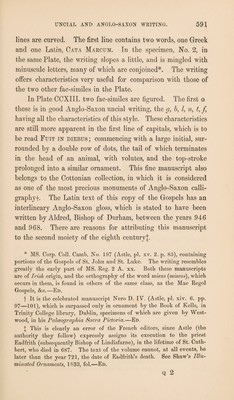
![Among these manuscripts is the one from which the specimen, No. 3, in Plate CCXII. is copied. It is a Psalter, contained in the Cottonian library at the British Museum4', which is traditionally affirmed to have belonged to St. Augustine. We must at once admit the Roman origin, direct or indi¬ rect, of this manuscript, since its text exhibits a perfect model of small square uncial characters, very regular and well spaced, with the words divided, and without any tendency to the minuscule forms. The A in the first line of the Psalm is flat¬ tened at the top, the I introduced within the D, and the entire line, terminated by letters arranged vertically over each other, is to be read Dileg am te dne [Domine]. The spiral orna¬ ments of the initial letter are especially remarkable, and as all these large letters are without doubt of Anglo-Saxon form, it may be conjectured, that an Italian scribe executed this fine manuscript, and formed his capitals according to the Anglo- Saxon style, which might carry the date of this volume towards the period of the mission of St. Augustine among the Anglo- Saxons, at the close of the sixth century. The same date is ascribed to the manuscript j- which has furnished the specimen, No. 1, in the same Plate. The top line is written in fine capitals, purely Anglo-Saxon, as is also the text, in small characters. The influence of the Augusti- nian missionaries is here, however, entirely lost, which would lead us to assign a somewhat later date to this fine volume. The letters in the first line are all square, but in the remaining * Vespasian A. I. (In Astle, pi. ix. p. 82.) See a more satisfactory fac-simile and account of this valuable manuscript in Westwood’s Palceo- graphia Sacra Pictoria.—Ed. t From the Cottonian MS. Otho C.V. (Astle, pi. xv. 1. p. 98), which is erroneously stated by Astle and Planta to have entirely perished in the fire of 1731. Fragments of about sixty leaves still remain, and among them the leaf from which the present fac-simile was taken. It contained originally the entire Gospels of St. Matthew and St. Mark, and is, unques¬ tionably, of Irish origin, and probably of the seventh century.—Ed.](https://iiif.wellcomecollection.org/image/b29328226_0002_0232.jp2/full/800%2C/0/default.jpg)
 No text description is available for this image
 No text description is available for this image
 No text description is available for this image