Volume 2
Universal palaeography, or, Fac-similes of writings of all nations and periods, copied from the most celebrated and authentic manuscripts in the libraries and archives of France, Italy, Germany, and England / by M.J.B. Silvestre ; accompanied by an historical and descriptive text and introduction by Champollion-Figeac and Aimé Champollion, fils ; translated from the French and edited, with corrections and notes, by Sir Frederic Maddan ... in two volumes.
- Joseph-Balthazar Silvestre
- Date:
- 1849-1850
Licence: Public Domain Mark
Credit: Universal palaeography, or, Fac-similes of writings of all nations and periods, copied from the most celebrated and authentic manuscripts in the libraries and archives of France, Italy, Germany, and England / by M.J.B. Silvestre ; accompanied by an historical and descriptive text and introduction by Champollion-Figeac and Aimé Champollion, fils ; translated from the French and edited, with corrections and notes, by Sir Frederic Maddan ... in two volumes. Source: Wellcome Collection.
285/458 page 643
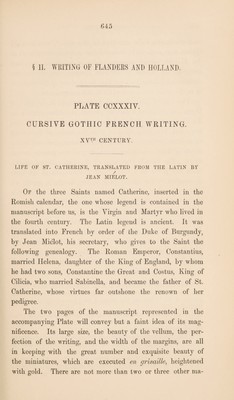
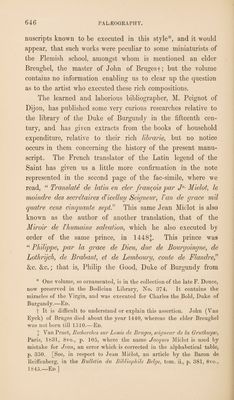
![note, attached to the cover of the volume, states that it was found “par les commissaires de la section Beaurepaire, dans une de leurs visitesat the period of the popular govern¬ ment of the sections of Paris, when the manuscript was sent to the Bibliotheque Royale. (Anc. fonds, No. 8175.) Not¬ withstanding this account, the present volume coincides in size and arrangement in double columns with de RobieiTs manuscript, and contains also various religious pieces, homilies on the Scriptures, and treatises of St. Ambrose, together with the lives of St. Patrick and Brigid. St. Bernard is named in it; serpentine Anglo-Saxon initials are numerous; and, what is of more consequence, the date 1441* is introduced in a note, which appears to contain the name of the scribe of that part of the volume, a specimen of which is given in the first column of the fac-simile, commencing with a large F in red. The volume is written by several scribes, and perhaps at various periods, and its contents are not arranged in the order given by the Benedictines, but may have been altered, when the manuscript was bound, about twelve years agof. In its present state, four different hands at least may be recog¬ nized, exclusive of some short notes, written on the margins, one of which is dated 1573. The fac-simile exhibits three initial Anglo-Saxon serpen¬ tine letters, being three IPs. The first line is in uncials of the same kind, Fovet in principio V\ir\go M[aria\ meo, as well as the word Domine in the paragraph beneath, which proceeds, qnis kabitabit in tabirnaculo tuo, ant quis requiecit in mo\n\te sco [sancto] tuo. The two paragraphs in the * The date is 1443; and the note states that this tract was translated into Irish by William Maguibne [Mac Gawney], at the request of Daniel O’Connell.—Ed. t The bindings of the MSS. in the Bibliotheque Royale bear the arms of the sovereigns who reigned when they were bound. The series is complete from the time of Charles VIII.](https://iiif.wellcomecollection.org/image/b29328226_0002_0285.jp2/full/800%2C/0/default.jpg)
 No text description is available for this image
 No text description is available for this image
 No text description is available for this image