Volume 2
Universal palaeography, or, Fac-similes of writings of all nations and periods, copied from the most celebrated and authentic manuscripts in the libraries and archives of France, Italy, Germany, and England / by M.J.B. Silvestre ; accompanied by an historical and descriptive text and introduction by Champollion-Figeac and Aimé Champollion, fils ; translated from the French and edited, with corrections and notes, by Sir Frederic Maddan ... in two volumes.
- Joseph-Balthazar Silvestre
- Date:
- 1849-1850
Licence: Public Domain Mark
Credit: Universal palaeography, or, Fac-similes of writings of all nations and periods, copied from the most celebrated and authentic manuscripts in the libraries and archives of France, Italy, Germany, and England / by M.J.B. Silvestre ; accompanied by an historical and descriptive text and introduction by Champollion-Figeac and Aimé Champollion, fils ; translated from the French and edited, with corrections and notes, by Sir Frederic Maddan ... in two volumes. Source: Wellcome Collection.
94/458 page 452
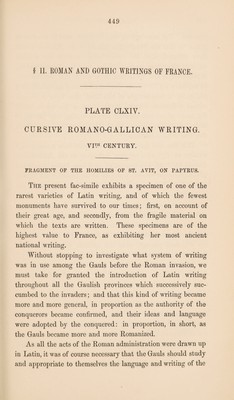
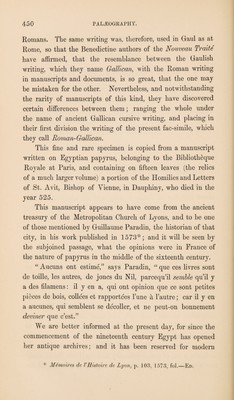
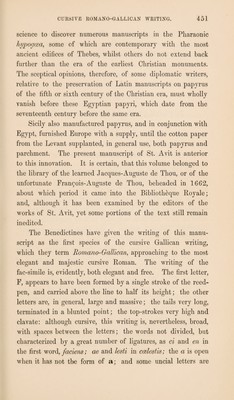
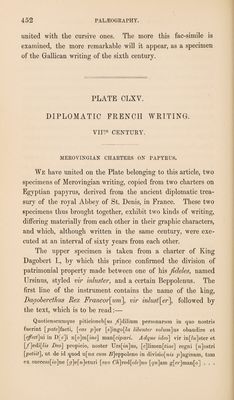
![united with the cursive ones. The more this fac-simile is examined, the more remarkable will it appear, as a specimen of the Gallican writing of the sixth century. PLATE CLXV. DIPLOMATIC FRENCH WRITING. VII™ CENTURY. MEROVINGIAN CHARTERS ON PAPYRUS. We have united on the Plate belonging to this article, two specimens of Merovingian writing, copied from two charters on Egyptian papyrus, derived from the ancient diplomatic trea¬ sury of the royal Abbey of St. Denis, in France. These two specimens thus brought together, exhibit two kinds of writing, differing materially from each other in their graphic characters, and which, although written in the same century, were exe¬ cuted at an interval of sixty years from each other. The upper specimen is taken from a charter of King Dagobert I., by which this prince confirmed the division of patrimonial property made between one of his fideles, named IJrsinus, styled vir inluster, and a certain Beppolenus. The first line of the instrument contains the name of the king, Dagobercthus Rex Francor\um\, vir inlust[^r], followed by the text, which is to be read:— Quotienscumque piticioneb[ws Ajclilium personamm in quo nostris fuerint [pate]facti, \eas p]er [s]ingo[£a libenter volum]us obaudire et \effect\m in D[Y]i n[o]m[me] man\cipari. Adque ideo] vir in[£a]ster et [/]edi[te's Deo] propicio, noster Urs[^]us, [c]limen[*tae] regni [n]ostri \petiit], ut de id quod u\na cum Sjeppoleno in division’s p]aginam, tam ex success[io]ne [^]e[?^]eturi [st/o Ch]vo({\ole]\\o [p]am g[er]man[o] . . .](https://iiif.wellcomecollection.org/image/b29328226_0002_0094.jp2/full/800%2C/0/default.jpg)
 No text description is available for this image
 No text description is available for this image
 No text description is available for this image