The constituents of the bark of "Prunus serotina" / by Frederick B. Power and Charles W. Moore.
- Frederick Belding Power
- Date:
- [1909?]
Licence: In copyright
Credit: The constituents of the bark of "Prunus serotina" / by Frederick B. Power and Charles W. Moore. Source: Wellcome Collection.
19/24 page 259
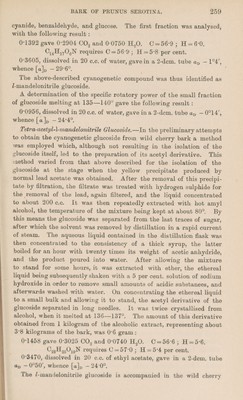
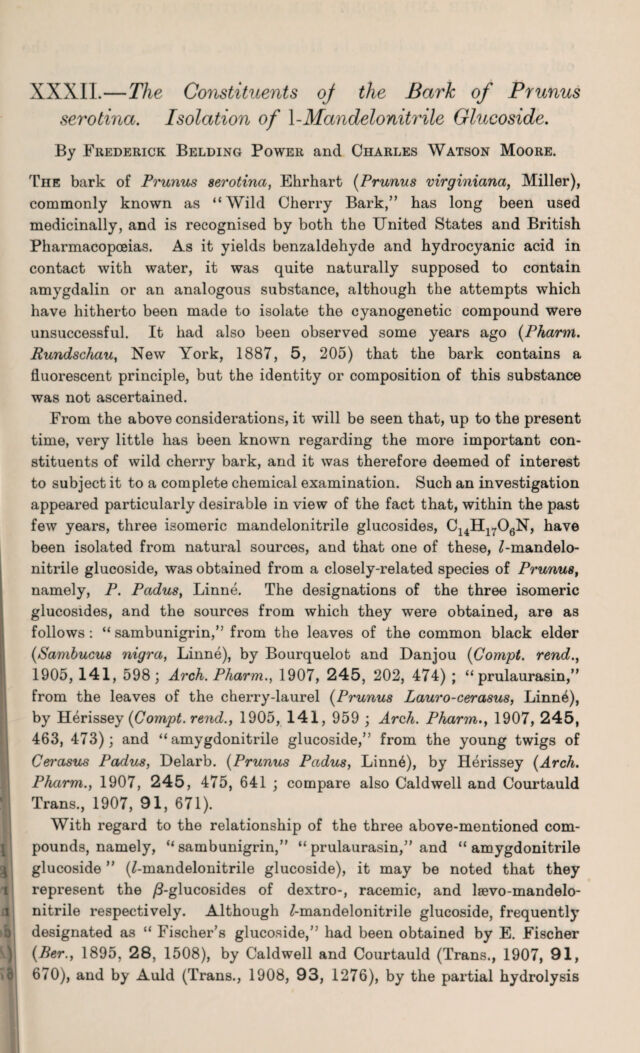
![cyanide, benzaldehyde, and glucose. The first fraction was analysed, with the following result : 0*1392 gave 0-2904 COa and 0-0750 HtO. 0 = 56-9; II = 6*0. C14Hl706N requires C = 56-9; H = 58 per cent. 0-3605, dissolved in 20 c.c. of water, gave in a 2-dcrn. tube aD — X°4', whence [a]D - 29-6°. The above-described cyanogenetic compound was thus identified as ^-mandelonitrile glucoside. A determination of the specific rotatory power of the small fraction of glucoside melting at 135—140° gave the following result : 00956, dissolved in 20 c.c. of water, gave in a 2-dcm. tube aD — 0°14', whence [a]D - 24*4°. Tetra-acetyl-\-mandelonitrile Glucoside.—In the preliminary attempts to obtain the cyanogenetic glucoside from wild cherry bark a method was employed which, although not resulting in the isolation of the glucoside itself, led to the preparation of its acetyl derivative. This method varied from that above described for the isolation of the glucoside at the stage when the yellow precipitate produced by normal lead acetate was obtained. After the removal of this precipi¬ tate by filtration, the filtrate was treated with hydrogen sulphide for the removal of the lead, again filtered, and the liquid concentrated to about 200 c.c. It was then repeatedly extracted with hot amyl alcohol, the temperature of the mixture being kept at about 80°. By this means the glucoside was separated from the last traces of sugar, after which the solvent was removed by distillation in a rapid current of steam. The aqueous liquid contained in the distillation flask was then concentrated to the consistency of a thick syrup, the latter boiled for an hour with twenty times its weight of acetic anhydride, and the product poured into water. After allowing the mixture to stand for some hours, it was extracted with ether, the ethereal liquid being subsequently shaken with a 5 per cent, solution of sodium hydroxide in order to remove small amounts of acidic substances, and afterwards washed with water. On concentrating the ethereal liquid to a small bulk and allowing it to stand, the acetyl derivative of the glucoside separated in long needles. It was twice crystallised from alcohol, when it melted at 136—137°. The amount of this derivative obtained from 1 kilogram of the alcoholic extract, representing about 3*8 kilograms of the bark, was 06 gram : 0-1458 gave 0-3025 C0.2 and 0-0740 H20. 0 = 56*6 ; 41 = 5-6. C32H26Oi0N requires C = 57-0; H = 5‘4 per cent. 0-3470, dissolved in 20 c.c. of ethyl acetate, gave in a 2-dcm. tube aD - 0°50', whence [a]D - 24 0°. The /-mandelonitrile glucoside is accompanied in the wild cherry](https://iiif.wellcomecollection.org/image/b30614375_0019.jp2/full/800%2C/0/default.jpg)