Minutes, Agricultural Biotechnology Research Advisory Committee, Working Group on Aquatic Biotechnology and Environmental Safety : September 28, 1994.
- United States. Agricultural Biotechnology Research Advisory Committee. Working Group on Aquatic Biotechnology and Environmental Safety
- Date:
- [1994]
Licence: Public Domain Mark
Credit: Minutes, Agricultural Biotechnology Research Advisory Committee, Working Group on Aquatic Biotechnology and Environmental Safety : September 28, 1994. Source: Wellcome Collection.
24/48 page 22
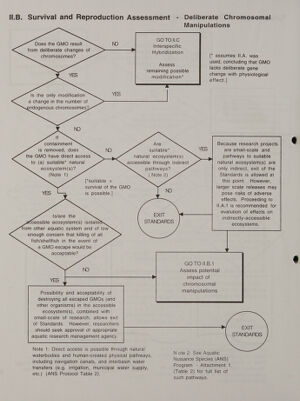
![Manipulations GO TO II.C Does the GMO result NO Interspecific from deliberate changes of Hybridization : chromosomes? [“ assumes II.A. was Assess used, concluding that GMO she lacks deliberate gene remaining possible chancatuihiphvsicled YES modification’ ge mln ipnysiological effect. |] YES Is the only modification a change in the number of endogenous chromosomes? Are suitable“ natural ecosystem(s) accessible through indirect pathways? ( Note 2) Because research projects are small-scale and pathways to suitable natural ecosystem(s) are only indirect, exit of the Standards is allowed at this point. However, larger scale releases may pose risks of adverse effects. Proceeding to I1.A.1 is recommended for evalution of effects on indirectly-accessible ecosystems. containment is removed, does the GMO have direct access to (a) suitable* natural ecosystem(s)? (Note 1) [“suitable = survival of the GMO is possible.] EXIT STANDARDS Is/are the accessible ecosystem(s) isolated from other aquatic system and of low enough concern that killing of all fish/shellfish in the event of a GMO escape would be acceptable? GO TO II.B.1 Assess potential impact of chromosomal manipulations Possibility and acceptability of destroying all escaped GMOs (and other organisms) in the accessible EXIT Note 1: Direct access is possible through natural waterbodies and human-created physical pathways, including navigation canals, and interbasin water transfers (e.g. irrigation, municipal water supply, etc.) (ANS Protocol Table 2). N ote 2: See Aquatic Nuisance Species (ANS) Program - Attachment 1. (Table 2) for full list of such pathways.](https://iiif.wellcomecollection.org/image/b32230072_0024.jp2/full/800%2C/0/default.jpg)

 No text description is available for this image
 No text description is available for this image
 No text description is available for this image