Minutes, Agricultural Biotechnology Research Advisory Committee, Working Group on Aquatic Biotechnology and Environmental Safety : September 28, 1994.
- United States. Agricultural Biotechnology Research Advisory Committee. Working Group on Aquatic Biotechnology and Environmental Safety
- Date:
- [1994]
Licence: Public Domain Mark
Credit: Minutes, Agricultural Biotechnology Research Advisory Committee, Working Group on Aquatic Biotechnology and Environmental Safety : September 28, 1994. Source: Wellcome Collection.
27/48 page 25
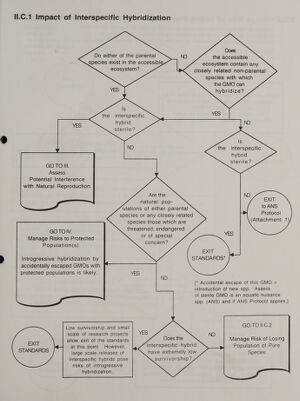
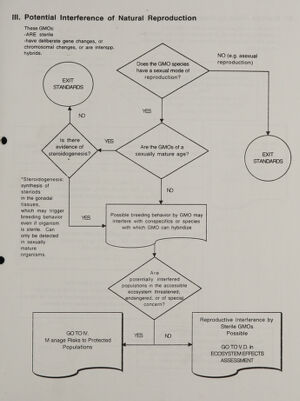
![Does the accessible ecosystem contain any closely related non-parental species with which the GMO can hybridize? Do either of the parental species exist in the accessible ecosystem? Is the interspecific hybrid sterile? Is the interspecific hybrid sterile? with Natural Reproduction Are the natural pop- ulations of either parental species or any closely related species those which are threatened, endangered or of special concern? EXIT to ANS Protocol (Attachment 1) GOTOIV. Manage Risks to Protected Population(s) Introgressive hybridization by accidentally escaped GMOs with protected populations is likely. YES STANDARDS* [* Accidental escape of this GMO = introduction of new spp. Assess of sterile GMO is an aquatic nuisance spp. (ANS) and if ANS Protocol applies.] Low survivorship and small GO TO II.C.2 scale of research projects | YES EXIT allow exit of the standards STANDARDS at this point. However, Does the interspecific hybrid have extremely low survivorship? Manage Risk of Losing Population of Pure](https://iiif.wellcomecollection.org/image/b32230072_0027.jp2/full/800%2C/0/default.jpg)
 No text description is available for this image
 No text description is available for this image
 No text description is available for this image