An outline for the quantitative analysis of urine / by Henry Erni.
- Erni, Henry
- Date:
- 1860
Licence: Public Domain Mark
Credit: An outline for the quantitative analysis of urine / by Henry Erni. Source: Wellcome Collection.
Provider: This material has been provided by the National Library of Medicine (U.S.), through the Medical Heritage Library. The original may be consulted at the National Library of Medicine (U.S.)
11/40
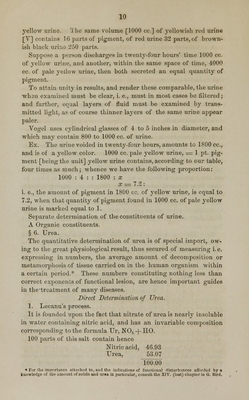
![mixing together different quantities of the following paints: gam- boge, carmine, and Prussian blue. A. Yellowish urines. 1. Pale yellow, like a weak solution of gamboge. 2. Bi'ight yellow, like a medium solution of gamboge. 3. Yellow, like a very strong solution of gamboge. B. Reddish urines. 4. Keddish yellow, like gamboge with a little carmine. 5. Yellowish red, like gamboge with more carmine. 6. Red, like carmine with a trace of gamboge. C. Brown [dark] urines. 7 Brownish red. 8. Reddish brown. 9. Brownish black. These nine shadings stand in certain relations to the quantity of coloring matter in the urine. It has recently been ascertained, that by the addition of water to a higher numbered specimen of urine, all the lower proceeding numbers can be prepared. In other words, all the variously colored urine may be looked upon as being de- rived from one and the same coloring ingredient, existing in differ- ent degi'ees of dilution. We must, however, except bile pigments and others, derived from food and medicines accidentally present. Quantitative experiments proved that, if a certain number of urine is diluted with an equal bulk of water, we obtain the next lower one. Ex. Take of number five, which is yellowish red, 200 cc, and dilute it with 200 cc. of water, and the mixture will correspond to urine number four, reddish yellow, etc. The above scale of urines may therefore serve us for a quantitative determination of pigment in urine, to which purpose Vogel arranged the following table: I. II. III. 2 IV 8 V 16 VI VII. VIII. IX Pale Yellow, I. 1 2 04 128 2^6 1 4 4 8 16 32 64 128 Bright Yellow, II. 1 2 4 8 16 32 64 Yellow, III. 1 0 4 8 16 32 Redish Yellow, IV. 1 2 4 8 16 Yellowish Red, V. 1 2 1 4 2 1 8 4 2 1 Red, VI. Brownish Red, VII Redish Brown, VIII. Brownish Black, IX. To be able to express in numbers the relative proportions of pig- ment pi-esent in different samples of urine, Vogel takes that quan- tity of pigment as unit [1] which is contained in 1000 cc. of pale](https://iiif.wellcomecollection.org/image/b21118164_0011.jp2/full/800%2C/0/default.jpg)


 No text description is available for this image
 No text description is available for this image
 No text description is available for this image