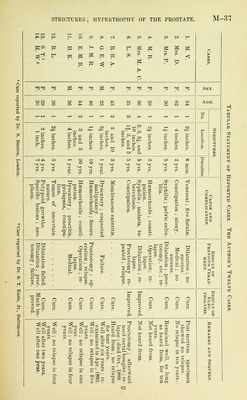
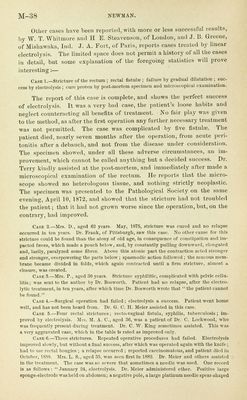
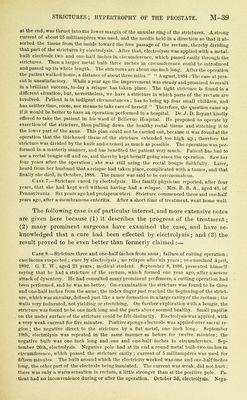
An international system of electro-therapeutics / ... By Horatio R. Bigelow ... and thirty-eight associate editors.
- Bigelow, Horatio R. (Horatio Ripley)
- Date:
- 1894
Licence: Public Domain Mark
Credit: An international system of electro-therapeutics / ... By Horatio R. Bigelow ... and thirty-eight associate editors. Source: Wellcome Collection.
Provider: This material has been provided by the Harvey Cushing/John Hay Whitney Medical Library at Yale University, through the Medical Heritage Library. The original may be consulted at the Harvey Cushing/John Hay Whitney Medical Library at Yale University.
1042/1236 page 40
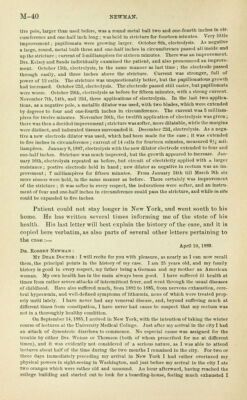
![tive pole, larger than used before, was a round metal ball two and one-fourth inches in cir- cumference and one-half inch long ; was held in stricture for fourteen minutes. Very little improvement; papillomata were growing larger. October 8th, electrolysis. As negative a large, round, metal bulb three and one-half inches in circumference passed all inside and up the stricture ; current of 5 milliamperes for sixteen minutes. There was an improvement. Drs. Kelsey and Sands individually examined the patient, and also pronounced an improve- ment. October 15th, electrolysis, in the same manner as last time ; the electrode passed through easily, and three inches above the stricture. Current was stronger, full of power of 12 cells. The stricture was unquestionably better, but the papillomatous growth had increased. October 22d, electrolysis. The electrode passed still easier, but papillomata were worse. October 29th, electrolysis as before for fifteen minutes, with a strong current. November 7th, 14th, and 22d, three applications of electrolysis. In the last two applica- tions, as a negative pole, a metallic dilator was used, with two blades, which were extended by degrees to four and one-fourth inches in circumference. The current was 5 milliam- peres for twelve minutes. November 30th, the twelfth application of electrolysis was given ; there was then a decided improvement; stricture was softer, more dilatable, while the margins were distinct, and indurated tissues surrounded it. December 22d, electrolysis. As a nega- tive a new electrode dilator was used, which had been made for the case ; it was extended to five inches in circumference ; current of 14 cells for fourteen minutes, measured &],i mil- liamperes. January 9,1887, electrolysis with the new dilator electrode extended to four and one-half inches. Stricture was much improved, but the growth appeared to increase. Jan- uary 16th, electrolysis repeated as before, but circuit of electricity applied with a larger resistance; postive electrode held in hand; new dilator as negative in rectum was an im- provement ; 7 milliamperes for fifteen minutes. From January 24th till March 9th six more seances were held, in the same manner as before. There certainly was improvement of the stricture ; it was softer in every respect, the indurations were softer, and an instru- ment of four and one-half inches in circumference could pass the stricture, and while in situ could be expanded to five inches. Patient could not stay longer in New York, and went south to his home. He has written several times informing me of the state of his health. His last letter will best explain the history of the case, and it is copied here verbatim, as also parts of several other letters pertaining to the case:— April 10, 1889. Dr. Robert Newman : My Dear Doctor : I will recite for you with pleasure, as nearly as I can now recall them, the principal points in the history of my case. I am 25 years old, and my family history is good in every respect, my father being a German and my mother an American woman. My own health has in the main always been good. I have suffered ill health at times from rather severe attacks of intermittent fever, and went through the usual diseases of childhood. Have also suffered much, from 1882 to 1885, from nervous exhaustion, cere- bral hyperemia, and well-defined symptoms of lithsemia, none of which were treated prop- erly until lately. I have never had any venereal disease, and, beyond suffering much at different times from constipation, I have never had cause to suspect that my rectum was not in a thoroughly healthy condition. On September 14,1885,1 arrived in New York, with the intention of taking the winter course of lectures at the University Medical College. Just after my arrival in the city I had an attack of dysenteric diarrhoea to commence. No especial cause was assigned for the trouble by either Drs. Weisse or Thomson (both of whom prescribed for me at different times), and it was evidently not considered of a serious nature, as I was able to attend lectures about half of the time during the two months I remained in the city. For two or three days Immediately preceding my arrival in New York I had rather overtaxed my physical powers in sight-seeing in Washington, and just before my arrival in the city I ate two oranges which were rather old and unsound. An hour afterward, having reached the](https://iiif.wellcomecollection.org/image/b21033705_1042.jp2/full/800%2C/0/default.jpg)