Annual report of the Director, Medical & Health Department / Colony of Mauritius.
- Mauritius. Medical and Health Department
- Date:
- [1906]
Licence: Public Domain Mark
Credit: Annual report of the Director, Medical & Health Department / Colony of Mauritius. Source: Wellcome Collection.
91/106 (page 74)
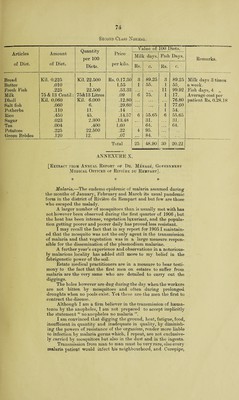
![Second Class Normal. Articles of Diet. Amount of Diet. Quantity per 100 Diets. Price per kilo. V alue of 100 Diets. Remarks. Milk days. Fish Days. Rs. c. Rs. c. Bread Kil. 0.225 Kil. 22.500 Rs. 0.17.30 3 89.25 3 89.25 Milk days 3 times Butter .010 1. 1.55 1 55. 1 55. a week. Fresh Fish .225 22.500 .53.33 • • • . . • 11 99.92 Fish days, 4 ,, Milk 75 & 13 Centil: 75&13 Litres .09 6 75. 1 17. Average cost per Dholl Kil. 0.060 Kil. 6.000 .12.80 • • • , . . • • • 76.80 patient Rs. 0.28.18 Salt fish .060 6. .29.60 . • » 1 77.60 Potherbs .110 11. .14 l 54. Rice .450 45. .14.57 6 55.65 6 55.65 Sugar .023 2.300 .13.48 31. • . ■ 31. Tea .004 .400 1.60 64. ... 64. Potatoes .225 22.500 .22 4 95. ... Green Bredes .120 12. .07 • . . 84. . . . Total ... 25 48.90 30 20.22 ANNEXUBE N. [Extract from Annual Report op Dr. Menage, Government Medical Officer of Riviere du Rempart]. * * * Malaria.—The endemo epidemic of malaria assumed during the months of January, February and March its usual pandemic form in the district of Riviere du Rempart and but few are those who escaped the malady. A larger number of mosquitoes than is usually met with has not however been observed during the first quarter of 1906 ; but the heat has been intense, vegetation luxuriant, and the popula¬ tion getting poorer and poorer daily has proved less resistant. I may recall the fact that in my report for 1905 I maintain¬ ed that the mosquito was not the only agent in the transmission of malaria and that vegetation was in a large measure respon¬ sible for the dissemination of the plasmodium malariae. A further year's experience and observations in a notorious¬ ly malarious locality has added still more to m}^ belief in the febrigenetic power of the soil. Estate medical practitioners are in a measure to bear testi¬ mony to the fact that the first men on estates to suffer from malaria are the very same who are detailed to carry out the diggings. The holes however are dug during the day when the workers are not bitten by mosquitoes and often during prolonged droughts when no pools exist. Yet these are the men the first to contract the disease. Although I am a firm believer in the transmission of haema- tozoa by the anopheles, I am not prepared to accept implicitly the statement “ no anopheles no malaria ”. I am convinced that digging the ground, heat, fatigue, food, insufficient in quantity and inadequate in quality, by diminish¬ ing the powers of resistance of the organism, render more liable to infection by malaria germs which, I repeat, are not exclusive¬ ly carried by mosquitoes but also in the du3t and in the ingesta. Transmission from man to man must be very rare, else every malaria patient would infect his neighbourhood, and Curepipe,](https://iiif.wellcomecollection.org/image/b31483951_0091.jp2/full/800%2C/0/default.jpg)