Durham at the opening of the twentieth century : contemporary biographies.
- Jamieson, James
- Date:
- 1906
Licence: In copyright
Credit: Durham at the opening of the twentieth century : contemporary biographies. Source: Wellcome Collection.
18/312 (page 8)
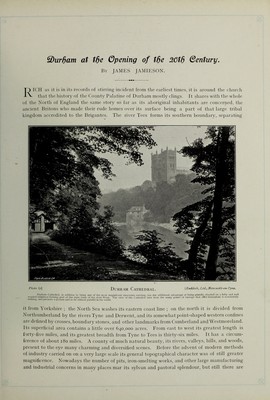
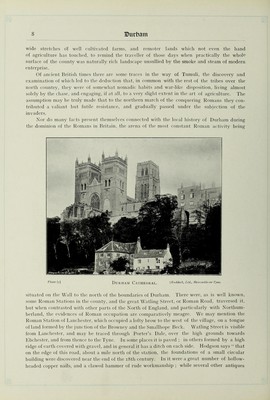
![wide stretches of well cultivated farms, and remoter lands which not even the hand of agriculture has touched, to remind the traveller of those days when practically the whole surface of the county was naturally rich landscape unsullied by the smoke and steam of modern enterprise. Of ancient British times there are some traces in the way of Tumuli, the discovery and examination of which led to the deduction that, in common with the rest of the tribes over the north country, they were of somewhat nomadic habits and war-like disposition, living almost solely by the chase, and engaging, if at all, to a very slight extent in the art of agriculture. The assumption may be truly made that to the northern march of the conquering Romans they con- tributed a valiant but futile resistance, and gradually passed under the subjection of the invaders. Nor do many facts present themselves connected with the local history of Durham during the dominion of the Romans in Britain, the arena of the most constant Roman activity being Photo by] Durham Cathedral. iRuddock, Ltd., Newcastu-on-Tync. situated on the Wall to the north of the boundaries of Durham. There were, as is well known, some Roman Stations in the county, and the great Watling Street, or Roman Road, traversed it, but when contrasted with other parts of the North of England, and particularly with Northum- berland, the evidences of Roman occupation are comparatively meagre. We may mention the Roman Station of Lanchester, which occupied a lofty brow to the west of the village, on a tongue of land formed by the junction of the Browney and the Smallhope Beck. Watling Street is visible from Lanchester, and may be traced through Porter’s Dale, over the high grounds towards Ebchester, and from thence to the Tyne. In some places it is paved ; in others formed by a high ridge of earth covered with gravel, and in general it has a ditch on each side. Hodgson says “ that on the edge of this road, about a mile north of the station, the foundations of a small circular building were discovered near the end of the 18th century. In it were a great number of hollow- headed copper nails, and a clawed hammer of rude workmanship ; while several other antiques](https://iiif.wellcomecollection.org/image/b24850305_0018.jp2/full/800%2C/0/default.jpg)