Durham at the opening of the twentieth century : contemporary biographies.
- Jamieson, James
- Date:
- 1906
Licence: In copyright
Credit: Durham at the opening of the twentieth century : contemporary biographies. Source: Wellcome Collection.
22/312 (page 12)
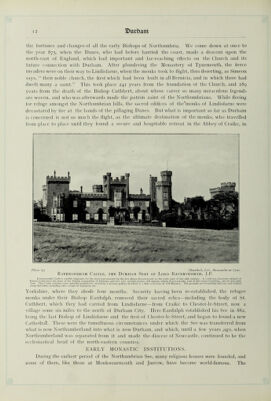
![the fortunes and changes of all the early Bishops of Northumbria. We come down at once to the year 875, when the Danes, who had before harried the coast, made a descent upon the north-east of England, which had important and far-reaching effects on the Church and its future connection with Durham. After plundering the Monastery of Tynemouth, the fierce invaders were on their way to Lindisfarne, when the monks took to flight, thus deserting, as Simeon says, “ their noble church, the first which had been built in all Bernicia, and in which there had dwelt many a saint.” This took place 241 years from the foundation of the Church, and 189 years from the death of the Bishop Cuthbert, about whose career so many miraculous legends are woven, and who was afterwards made the patron saint of the Northumbrians. While fleeing for refuge amongst the Northumbrian hills, the sacred edifices of the*monks of Lindisfarne were devastated by fire at the hands of the pillaging Danes. But what is important so far as Durham is concerned is not so much the flight, as the ultimate destination of the monks, who travelled from place to place until they found a secure and hospitable retreat in the Abbey of Craike, in Photo by] [Ruddock, Lt-t., Newcastle-on-Tyne. Ravensworth Castle, the Durham Seat of Lord Ravensworth, J.P. Ravensworth Castle is a noble structure, for the most part erected by the first Baron Ravensworth in the early part of the 19th century. A castle lias, however, existed at Ravensworth since the time of the Danish occupation of Durham, and two very ancient towers still remain, which, if not actually part of the original building, are of very early date. The Castle contains some splendid apartments, including a picture gallery in which is a fine collection of Old Masters. The grounds are beautifully laid out, and contain many fine trees, including oaks, cedars of Lebanon, etc. Yorkshire, where they abode four months. Security having been re-established, the refugee monks under their Bishop Eardulph, removed their sacred relics—including the body of St. Cuthbert, which they had carried from Lindisfarne—from Craike to Chester-le-Street, now a village some six miles to the north of Durham City. Here Eardulph established his See in 882, being the last Bishop of Lindisfarne and the first of Chester-le-Street, and began to found a new Cathedral. These were the tumultuous circumstances under which the See was transferred from what is now Northumberland into what is now Durham, and which, until a few years .ago, when Northumberland was separated from it and made the diocese of Newcastle, continued to be the ecclesiastical head of the north-eastern counties. EARLY MONASTIC INSTITUTIONS. During the earliest period of the Northumbrian See, many religious houses were founded, and some of them, like those at Monkwearmouth and Jarrow, have become world-famous. The](https://iiif.wellcomecollection.org/image/b24850305_0022.jp2/full/800%2C/0/default.jpg)