Durham at the opening of the twentieth century : contemporary biographies.
- Jamieson, James
- Date:
- 1906
Licence: In copyright
Credit: Durham at the opening of the twentieth century : contemporary biographies. Source: Wellcome Collection.
24/312 (page 14)
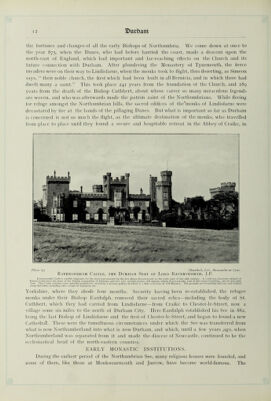
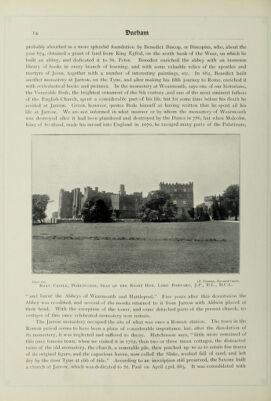
![probably absorbed in a more splendid foundation by Benedict Biscop, or Biscopius, who, about the year 674, obtained a grant of land from King Egfrid, on the north bank of the Wear, on which he built an abbey, and dedicated it to St. Peter. Benedict enriched the abbey with an immense library of books in every branch of learning, and with some valuable relics of the apostles and martyrs of Jesus, together with a number of interesting paintings, etc. In 682, Benedict built another monastery at Jarrow, on the l'yne, and after making his fifth journey to Rome, enriched it with ecclesiastical books and pictures. In the monastery at Wearmouth, says one of our historians, the Venerable Bede, the brightest ornament of the 8th century ,and one of the most eminent fathers of the English Church, spent a considerable part of his life, but for some time before his death he resided at {arrow. Green, however, quotes Bede himself as having written that he spent all his life at Jarrow. We are not informed in what manner or by whom the monastery of Wearmouth was destroyed after it had been plundered and destroyed by the Danes in 786, but when Malcolm, King of Scotland, made his inroad into England in 1070, he ravaged many parts of the Palatinate, Photo by] [£. Yeoman, Barnard Castle. Raby Castle, Darlington, Seat of the Right Hon. Lord Barnard, J.P., D.L., D.C.L. “ and burnt the Abbeys of Wearmouth and Hartlepool.” Five years after this devastation the Abbey was re-edified, and several of the monks returned to it from Jarrow with Aldwin placed at their head. With the exception of the tower, and some detached parts of the present church, no vestiges of this once celebrated monastery now remain. The Jarrow monastery occupied the site of what was once a Roman station. '1 he town in the Roman period seems to have been a place of considerable importance, but, after the dissolution of its monastery, it was neglected and suffered to decay. Hutchinson says, ‘‘little more remained of this once famous town, when we visited it in 1782, than two or three mean cottages, the distracted ruins of the old monastery, the church, a venerable pile, then patched up so as to retain few traces of its original figure, and the capacious haven, now called the Slake, washed full of sand, and left dry by the river Tyne at ebb of tide.” According to an inscription still preserved, the Saxons built a church at Jarrow, which was dedicated to St. Paul on April 23rd, 685. It was consolidated with](https://iiif.wellcomecollection.org/image/b24850305_0024.jp2/full/800%2C/0/default.jpg)