Durham at the opening of the twentieth century : contemporary biographies.
- Jamieson, James
- Date:
- 1906
Licence: In copyright
Credit: Durham at the opening of the twentieth century : contemporary biographies. Source: Wellcome Collection.
25/312 (page 15)
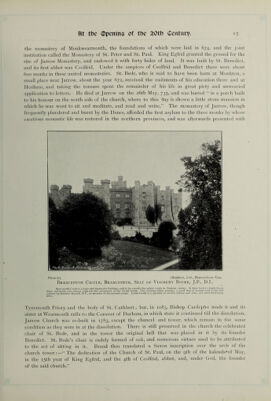
![the monastery of Monkwearmouth, the foundations of which were laid in 674, and the joint institution called the Monastery of St. Peter and St. Paul. King Egfrid granted the ground for the site of Jarrow Monastery, and endowed it with forty hides of land. It was built by St. Benedict, and its first abbot was Ceolfrid. Under the auspices of Ceolfrid and Benedict there were about 600 monks in these united monasteries. St. Bede, who is said to have been born at Monkton, a small place near Jarrow, about the year 672, received the rudiments of his education there and at Hexham, and taking the tonsure spent the remainder of his life in great piety and unwearied application to letters. He died at Jarrow on the 26th May, 735, and was buried “ in a porch built to his honour on the north side of the church, where to this day is shown a little stone mansion in which he was wont to sit and meditate, and read and write,” The monastery of Jarrow, though frequently plundered and burnt by the Danes, afforded the first asylum to the three monks by whose exertions monastic life was restored in the northern provinces, and was afterwards presented with Photo by] [Ruddock, Ltd., Newcastle-on-Tyne. Brancepeth Castle, Brancepeth, Seat of Viscount Boyne, J.P., D.L. Brancepeth Castle is a large and impressive building, said to be actually the oldest castle in Durham county. It dates back to Anglo-Saxon times, and in the 12th century came into the possession of the Nevill family. The existing fabric contains a good deal of ancient work in the 18th century by Matthew Russell, M.P., an ancestor of the present owner. In the Castle is a quantity of ancient armour and arms, and other interesting relics. Tynemouth Priory and the body of St. Cuthbert; but, in 1083, Bishop Canlepho made it and its sister at Wearmouth cells to the Convent of Durham, in which state it continued till the dissolution. Jarrow Church was re-built in 1783, except the chancel and tower, which remain in the same condition as they were in at the dissolution. There is still preserved in the church the celebrated chair of St. Bede, and in the tower the original bell that was placed in it by its founder Benedict. St. Bede’s chair is rudely formed of oak, and numerous virtues used to be attributed to the act of sitting in it. Brand thus translated a Saxon inscription over the arch of the church tower:—“ The dedication of the Church of St. Paul, on the 9th of the kalends’of May, in the 15th year of King Egfrid, and the 4th of Ceolfrid, abbot, and, under God, the founder of the said church.”](https://iiif.wellcomecollection.org/image/b24850305_0025.jp2/full/800%2C/0/default.jpg)