Durham at the opening of the twentieth century : contemporary biographies.
- Jamieson, James
- Date:
- 1906
Licence: In copyright
Credit: Durham at the opening of the twentieth century : contemporary biographies. Source: Wellcome Collection.
38/312 (page 28)
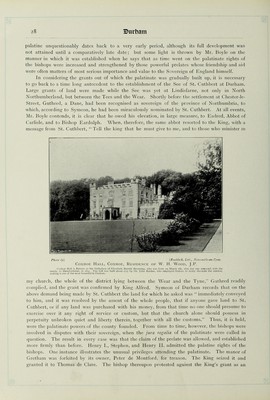
![palatine unquestionably dates back to a very early period, although its full development was not attained until a comparatively late date; but some light is thrown by Mr. Boyle on the manner in which it was established when he says that as time went on the palatinate rights of the bishops were increased and strengthened by those powerful prelates whose friendship and aid were often matters of most serious importance and value to the Sovereign of England himself. In considering the grants out of which the palatinate was gradually built up, it is necessary to go back to a time long antecedent to the establishment of the See of St. Cuthbert at Durham. Large grants of land were made while the See was yet at Lindisfarne, not only in North Northumberland, but between the Tees and the Wear. Shortly before the settlement at Chester-le- Street, Guthred, a Dane, had been recognised as sovereign of the province of Northumbria, to which, according to Symeon, he had been miraculously nominated by St. Cuthbert. At all events, Mr. Boyle contends, it is clear that he owed his elevation, in large measure, to Eadred, Abbot of Carlisle, and to Bishop Eardulph. When, therefore, the same abbot resorted to the King, with a message from St. Cuthbert, “Tell the king that he must give to me, and to those who minister in Photo by] \Ruddock, Ltd., Newcastle-on-Tyne. Coxhoe Hall, Coxhoe, Residence of W. H. Wood, J.P. Coxhoe Hall is famous as the birthplace of Elizabeth Barrett Browning, who was born on March 6th, 1806, but was removed, with the family, to Herefordshire, in 1809. The hall was built about 1725 by Mr. John Burdon, who employed Italians to richly decorate the interior, making it one of the most beautiful in Durham. my church, the whole of the district lying between the Wear and the Tyne,’’ Guthred readily complied, and the grant was confirmed by King Alfred. Symeon of Durham records that on the above demand being made by St. Cuthbert the land for which he asked was “ immediately conveyed to him, and it was resolved by the assent of the whole people, that if anyone gave land to St. Cuthbert, or if any land was purchased with his money, from that time no one should presume to exercise over it any right of service or custom, but that the church alone should possess in perpetuity unbroken quiet and liberty therein, together with all the customs.” 1 hus, it is held, were the palatinate powers of the county founded. From time to time, however, the bishops were involved in disputes with their sovereign, when the jura regalia of the palatinate were called in question. The result in every case was that the claim of the prelate was allowed, and established more firmly than before. Henry I., Stephen, and Henry II. admitted the palatine rights of the bishops. One instance illustrates the unusual privileges attending the palatinate. The manor of Gretham was forfeited by its owner, Peter de Montford, for treason. The King seized it and granted it to Thomas de Clare. The bishop thereupon protested against the King’s grant as an](https://iiif.wellcomecollection.org/image/b24850305_0038.jp2/full/800%2C/0/default.jpg)