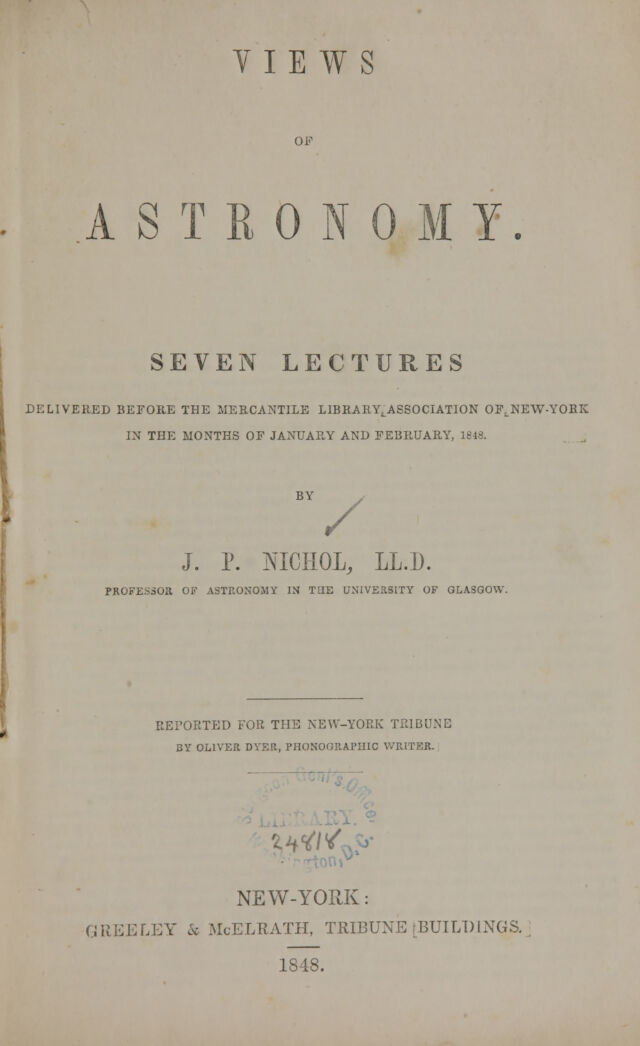
Views of astronomy : seven lectures delivered before the Mercantile Library Association of New York in the months of January and February, 1848 / by J.P. Nichol ; reported for the New-York Tribune by Oliver Dyer.
- John Pringle Nichol
- Date:
- 1848
Licence: Public Domain Mark
Credit: Views of astronomy : seven lectures delivered before the Mercantile Library Association of New York in the months of January and February, 1848 / by J.P. Nichol ; reported for the New-York Tribune by Oliver Dyer. Source: Wellcome Collection.
Provider: This material has been provided by the National Library of Medicine (U.S.), through the Medical Heritage Library. The original may be consulted at the National Library of Medicine (U.S.)
22/52
![Prof. NichoVa Lectures. forwtV0 fnncratethevariedfantasie3 brought forward not without adequate solemnity, as proba X.S?: nH'-lf f arfng th!8e remarka°'e d'iscre- £n?l?V norsThallI re/er, and that very briefly, ex were.Wa I,nthe firSt ^lace> the discrepancies were supposed to result from om«few*-not to be- caules of%°rdZ°{ °«8^tem, but to originate in custom 0of,.tS^r; and' according to established custom, alike in Astronomy and Geology, the action ot a Comet was invoked as the magnus Apollo! One of these wandering bodies, it was said, had, in the course of its devious path through our system come into contact with Uranus-struck it, in fact- and, by introducing a new cause of motion, pro- duced the discrepancy we discern between the course of the planet at the epoch of these oldest observations, and its subsequent movements. ]t is perfectly certain, indeed, that such a disturbance would have produced a great deviation, or apparent breach of continuity. The planet's path would, in that case, have consisted of parts of two different orbits, joined at the point of concussion; but even it its course prior to and after 1780 had been parts of two independent orbits, internally consistent or har- monious with known law— which they are not— is it not clear that another comet and another shock were requisite after 1820, to account for the second breach ol continuity—that second departure of the planet from the course laid down by BouvaRd ? If one accident might, without the support of observa- tion of the fact, have been received as possible, the occurrence of too such is opposed by all the laws of probability; and the hypothesis might, accordingly, have been rejected, even without the elaborate de- monstration of its inapplicability to the details of either case. Nay, this consideration goes farther, it forbids our referring—unless distinctly upheld by observation—the anomaly to any accident what ever; for it is quite inadmissable to suppose the- recurrence, in circumstances so similar, of what in its very essence is capricious—an exception, by hy- pothesis, to all known law or order. We must dis- miss, therefore, the hope of receiving a solution from accident.—Another assumption which received high favor, must also bo mentioned here, as of the kind I term preliminary. The calculations of Bou- vard, it will be noticed, rest wholly on the supposi- tion of I he integrity of the law of Gravitation: now, may not these resulting inconsistencies hare their root in the erroneousnest of /his fundamental as- sumption ? The law of Gravity extends as far as Saturn : but, may it not have uudergone roodiliea- tion, in those pro'onnder remotenesses from the Sun, through which Uranus revolves in its circuit? This view seemed at one time a favorite with the illustrious Bksskl : nor has it, on the occurrence of other difficulties, been deemed illegitimate to con- aider it possible that Gravitation may alter. Ill i nun mo c&picsBiuiiui juur miiuiruuou urespeciui truth, we have no reason to suppose this great the immensity of the sheerest and most unmitigat- - ed toil, undergone in this great research. Thefinal proved of no avail If the law of Gravity must be challenged, then, the time for that is not at the beginning of our consideration of this difficulty J£jJZ> T haVS tri?d eve,7 circumstance! which—the law remaining entire—might affect the manner of its working, and so have demon- stra.ed that what is now an apparent contradic- tion, may not be only one of its more recondite and least obvious results.—We must postpone, there- fore, that Inquiry, although it had the merit of ro- ceivmg the approbation of Bessel.- Dismissing the idea, then, that such anomalies can arise from accident, and postponing the chal- lenge of the Law of Gravity until every other re- source has been exhausted—we find ourselves be- tween the following alternatives : Either we are ignorant of all the conditions within which Uranus is moving,—j. e. we know not the whole of the bo- dies acting on that planet; or we have not inter- preted aright the effect of known conditions. In the course of a truly logical treatment cf the ques- tion, the latter alternative must first be examined: and this examination necessarily consists in a re- vision of the theory given by Laplace con- cerning the action of Saturn and Jupiter,— in the scrutiny of Bouvard's calculations,—and in the discussion of the Inquiry alluded to a short time since, viz: whether, by varying the normal Ellipse within the limits which confine it, and thereby altering the quantities which we ascribe to the deflecting influences of those two large Planets—the existing inconsistencies may not be made to disappear? It was indeed appa- rently a hopeless idea, that the skill of the author of the Mecanique Celeste might here have failed, or the persevering sagacity of Boduvar ; but in, presence of a difficulty so startling—of an anomaly so unmanageable amid the harmonies of our System —no weight of authority could be allowed to forbid our exploring every chance of errcr; and, accord- ingly, one of the great men, concerning whom I am to speak, devoted himself at the outset to the im- mense calculations necessary to construct again from their very foundaiions.the theory and tables of Uranus. In the work of both cf his predecessors, Leverriek found room for modifications; and hav- ing effected these, he exhausted all possibilities of variation in regard of thenormal ellipse. Thedifiicul- ties were by this investigation, to some extent, di- minished ; but the startling anomaly remained in fullest force: so that every chance of mistake being banished, the fact stood forth as absolutely and un- questionably true—that there is a formal incompat- ibility between the observed motions of Uranus and the hypothesis that lie is acted on only by Hie Sun and known Planets, according to the Law of Uni- versal Uradiation —I must here, once for all, so- licit the expression of your admiration in respect of Law, as now revealed, to be the ultimate or situ plest, and therefore the universal and all compre- hensive form, of a great Ordinance. The mode in which its intensity diminishes with the t lenient of distance, has not the aspect of an ultimate Prttici- pie; which always assumes the simplicity and self evidence of those axioms that constitute the basis of Geometry: but there is a rule in philoso admits of no as phy, applicable to this matter, that admits of no dispute. Allowing fully that very few Laws, as discerned by Man, CHn be deemed essentially uni- versal—none, it may be. except those first prio ciples of the science of Form, by which eo many of the relations of different part, of the Universe are determined ;—it is yet clear that we are never ititled to challenge the universality of Laws that, ithm our experience, have nowhere railed—until »ry other mode of overcoming; the difficulty has with rrery other \,xm iui i| 'invii.'fc,v«iw iubuiD^iba> i i>oi <*i vn. a uv/Mum results of Astronomy are usually so dazzling that the mind of the rapt student easily goes in with the idea that the road leading to them is equally pleasant; a road through gardens—among flowers —and by running brooks ! Alas! alas! it is a hard and most weary path—across a moor without a blossom! No Siberian steppe can be more arid than the sphere of these labors of LevirbieR; nay, in every portion of Astronomy the labor of dry calculation has become so overpowering that the resources of Analysis lis ve of late been persever- iugly bestowed, on the discovery of modes of short- ening and checking these processes,—as one of the most effective means of increasing our power. Le- VKHRIKR was detained amid such calculations dur- ing the season of the year in which, as a first ap- proximation had informed him. his Planet was pas-](https://iiif.wellcomecollection.org/image/b21143821_0022.jp2/full/800%2C/0/default.jpg)


 No text description is available for this image
 No text description is available for this image
 No text description is available for this image