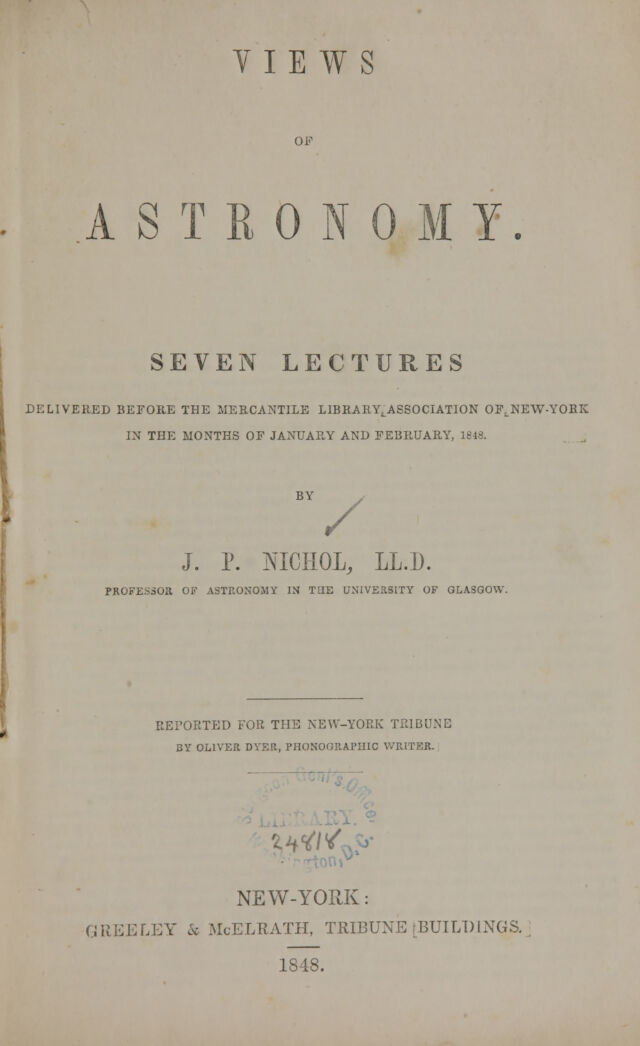
Views of astronomy : seven lectures delivered before the Mercantile Library Association of New York in the months of January and February, 1848 / by J.P. Nichol ; reported for the New-York Tribune by Oliver Dyer.
- John Pringle Nichol
- Date:
- 1848
Licence: Public Domain Mark
Credit: Views of astronomy : seven lectures delivered before the Mercantile Library Association of New York in the months of January and February, 1848 / by J.P. Nichol ; reported for the New-York Tribune by Oliver Dyer. Source: Wellcome Collection.
Provider: This material has been provided by the National Library of Medicine (U.S.), through the Medical Heritage Library. The original may be consulted at the National Library of Medicine (U.S.)
25/52
![the unknown orb is conceived to lie, he requires to ascertain whether any one has a planetary motion. But this cannot be discerned by a single inspec- tion. The motion at remotenesses like those with which we are now being conversant, must be so slow, that, for the brief time of one night, or even of several nights, it may be virtually equivalent to stillness ; so that it cannot be detected save in one way, viz : the careful comparison of the state of the Heavens on one night, with their state on some other night, separated from the lirst by a consider- able interval. Now, this comparison is not easily accomplished—nay, it involves great labor ; it re- quires that an accurate mapbf) made of all the small stars in the region of the sky under scrutiny, at these two several limes ; and to do this—to map the small stars in any region of the sky even once, in- volves a labor so great—taking the necessary ex- actitude into account—that Levereier gladly ex- pected the desired result from the visibility of a disc, and Fortune was again favorable ! For many years a great enterprise has been in the act of being performed by the Academy of Ber- lin—chiefly through the instigation of the illustri- ous Bessel. Convinced of the great importance of the work, especially with regard to such discoveries as this—the Academy undertood the mapping— with all the precision which our modern Instru- mets render possible—of the small stars along the entire Zodiac, or along that belt of the sky, where —from the analogy of the other parts of our system —new planets might be expected to be seen. The labor required to achieve this was enormous ; and it was divided among a great number of persons, hav- ing requisite instruments. Now, it so happened that the map of that precise region where the new planet was expected, had been completed by Dr. Bremiker; and it was printing, or just printed, at Berlin:—I believe that the Observatory of Berlin had obtained the proof-sheet. The Astronomers of this Institution were thus in a position of power re- garding such inquiries, enjoyed by no other Obser- vatory in existence: they had simply to notice Bremiker's Map and then the Sky—observing if there was a discrepancy between the two pictures, that could be accounted for by the planetary motion of some one star: so that—with their re- nowned sagacity, and the excellence of their instru- ments—an inspection of the Heavens on one clear night might accomplish the resolution of this great problem. And thus it even was ; the Planet was discovered actually by M. Galle, on the very eve- ning of the day on which he received the letter of Leverrier indicating its place. (Applause.) As ascertained by M. Galle, the heliocentric lon- gitude of the body for the epoch of 1st January, 1847, would be 327° 24 The predicted longitude 326 32 as before stated. The difference was, therefore, less than one degree or oDly fifty-two minutes! _ I am, indeed, aware that few grand discoveries have ever been achieved without some degree of previous disappointment on the part of the discov- erer. More or less enveloped in shadow they loom for years before his anxious eye, but the entire an- nals of Observation probably do not elsewhere ex- hibit so extraordinary a verification of any theoreti- cal conjecture adventured on by the human spirit f M. Leverrier received the cheering intelligence after he had concluded his last paper to the Insti- tute on the subject; and his bearing was too strik- ing and characteristic to allow me to omit reference to it. This success, says he, permits us to hope that after thirty or forty years of observation on the new Planet, we may employ it, in its turn, for the discovery of the one following it in its order of distances from the Sun. Thus, at least, we should unhappily soon fall among bodies invisible by reason of their immense distance, but whose or- bits might yet be traced in a succession of ages, with the greatest exactness, by the theory of Secu- lar Inequalities. Verily, what a man is this ! On hearing that he had done a deed unparalleled in scientific history—that to his thought of unexam- pled daring, even God's Starry Universe had re- sponded, and in its own splendid and imperishable language pronounced its verification—not one re- flex glance on himself, not a complacent smile on the isolated ME, which amid these infinitudes had been privileged to do a work, and therefore claimed and panted for its special homage, but a firm—a rejoicing and withal a reverential hope as to the progress of that Humanity, from participation with which his own strength will come—for the progress of that Human Spirit whose earthly destiny will not cease until, after the evolution of ages, that grand material imagery lies in all its mysterious gorgeonsness prostrate as spoils at its feet. (Great applause.) [Dr. Nichol here closed his lecture, although he had to leave untouched several of the most interesting points relating to the discovery of the planet Neptune ]](https://iiif.wellcomecollection.org/image/b21143821_0025.jp2/full/800%2C/0/default.jpg)