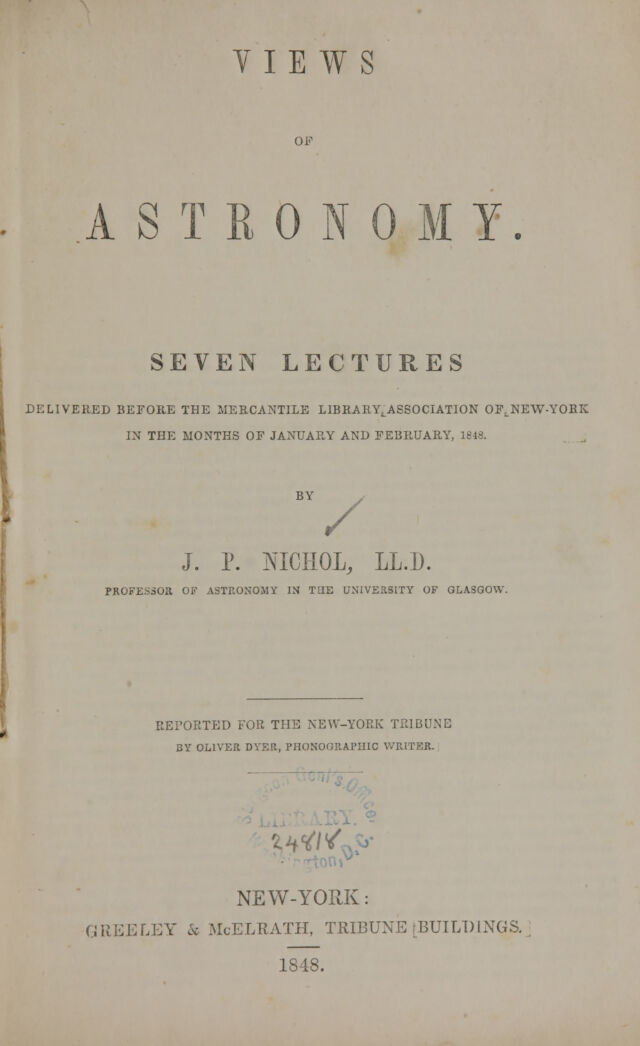
Views of astronomy : seven lectures delivered before the Mercantile Library Association of New York in the months of January and February, 1848 / by J.P. Nichol ; reported for the New-York Tribune by Oliver Dyer.
- John Pringle Nichol
- Date:
- 1848
Licence: Public Domain Mark
Credit: Views of astronomy : seven lectures delivered before the Mercantile Library Association of New York in the months of January and February, 1848 / by J.P. Nichol ; reported for the New-York Tribune by Oliver Dyer. Source: Wellcome Collection.
Provider: This material has been provided by the National Library of Medicine (U.S.), through the Medical Heritage Library. The original may be consulted at the National Library of Medicine (U.S.)
38/52
![flying about through space. If this matter dirt go back, where is it?—we certainly should see it if it was there. Therefore we may say it is probable thatthis matter did not go back to the Moon at all, but that the violence of the shock was sufficient to Bend it off to seek its own fortune through space. (Laughter and applause.) Then what became of it? It most be moving through space in strange orbits, iu bodies of different magnitudes. The orbits of the planets areso regalar that with them there is no chance for collision, but with these masses flying round through space there is no chance to escape collision, consequently it is to be expected that these masses would be continually coming in con- tact with the Earth. Thus may we account for the falling of Meteoric stones. This is not a strange phenomenon. At least two masses mast fall to the Earth per day—taking into account all that have been observed to fall—a phenomenon suffi- ciently large to reqaire some important cause.— Now, if this force had sent off this matter from the Moon, the Meteoric stones would not be difficult to explain. There was a theory concerning this phenome- non called the Chemical Theory, which, as far as I ever understood it, was this. Suppose certain particles floating about in the atmosphere, then suppose particular forces should cause these particles to come in contact and unite, then parti- cular stones would be the result. Now there are three difficulties attending this solution. First.it cannot be established that such particles were floating about in the atmosphere. Secondly—It cannot be proved that particular forces would cause them to unite;'' and thirdly, it cannot be shown that particular stones would result from their unition. (Laughter and applause) But let me return to our direct subject. We have now collected sufficient indications to entitle us to adventure some generalization regarding the Beat of the force whose results we have been ex- amining ; but it may be well in the first instance to cast a rapid glance at other craters than Tycho. And I would as another instance of this description of formation claim your attention for one moment to the crater Copernicus. This is one of the most beau- tiful craters on the Mood's surface. It is best seen at the full of the Moon It seems as if studded with pearls—a most beautiful object lying in the midst of a beautiful pearly light. When this light is analyzed we find that it, too, consists of a multi- tude of bands 6hining like those around Tycbo; but, unlike those first bands, they wind along through the valleys of the undulating countries, and seem more like our superficial streams of lava. This, however, is the most remarkable circumstance about Copernicus. Notwithstand- ing the violent effort necessary to produce it, the plain in its immediate neighborhood has been scarcely at all disturbed. This very memorable feature we remarked as connected with the iso- lated peak, and it is eminently characteristic of the whole class of minor craters. From this, truth of vast importance may bo immediately inferred, ■*iz : that the seat of the convulsion causing these craters cannot have beeu located deeply within the Moon's mass. A profound force, capable of pro- ducing such a crater, must, at the same time, have shattered a considerable portion of the Moon's sur- face. No theory, then, at all related to the prevail- ing conceptions of a central force can be applicable here. The aspects of the Moon are in tlvs respect wholly contradictory of the idea of a central force ; nay, a Geology formed upon the ground of the ap- pearances in the .Moon would not contain any notion of a central force. It seems to me, then, not ui.likely that that department ol existing Geolo- gical theory which is founded on tho supposed action of central forces, or ou supposed relation- ships between the crust of tho planets and their so called molten interiors, will ultimately undergo great modification. Another fact of great moment seems to be ren- dered probable by the Moon, namely, that in the course of time the upheaving energy has been be- coming less convulsive, or that an epoch of compar- ative stability has been approaching that body. [The Lecturer showed, here, by aid of diagrams, how the relative ages of the different craters might be approximately ascertained. It seems that Tycho isthe oldest formation, and that as the ageB proceed, the craters appear to have originated in less and less violent actions. This great fact also seems established in the Earth.] He then con- tinned : Connected with this curious subject there is a more general contemplation, on which notice should in conclusion be bestowed. What is termed the argument or consideration of Final Causes; that is an attempt to view any portion of the known Creation as an indication of the original purpose of the Divinity has ever seemed to me one which the human faculties cannot now undertake; for I can- not persuade myself that all the fitnesses that we see, multiplex as they are, go to constitute the en- tire of that scheme which the Almighty, from the innate necessities of his own perfections, deter- mined from the beginning. It is thus, as I think, that every scheme observed by man has within it much of mystery, or, what is the same thing, points not accounted for, just because these touch on re- moter forms of being and mightier plaus. But though it isdenied us tospeak dogmatically in regard of anything that we can see of the ultimate cr pri- mary purposes of God; in no part of creation, great or small, when understood aright is want of har- mony descried, or that adaptation which tells of the exquisiteness of the workof an Omniscient and Omnipotent Creator. In reference to the scenes over which tonight we have traveled, we have found the long existence of eras of unsettlement and commotion, and a promise of a period of re- pose. Sympathizing with inorganic Nature, and toiling alone with her, the vital energies have aa- cordingly all along accommodated their products to these vast transitions. Passing by the primal ages, it seems clear that only when Nature's ac- tions became so ordered that in the main they could foresee by ordinary prudence, was the Earth a fitting habitation for a being gifted with pure rea- son and will, and thereby cat loose from the safe- guard of pure instinct. 1 think the audience will understand this idea.— We can imagine creatures of instinct fitted to live in any state iu the world. We know that the in- stincts of animals forewarn them of dangers which man with all his boasted reason cannot foresee. These beings of instinct can in many cases foresee some ofthe sreatcalamitiesof Nature, such as earth- quakes, volcanic eruptions, etc. The beines of rea- son could not understand the approach of these dan- gers. A world may be adapted to the abode of be- ings under the control of instinct which would not be at all adapted to the abode of those compelled to trust for safety to their reason alone. We know thatthereare some portions of the Earth unfitted at the present time for the habitation of Man—regions where theerections of civilization for years are over- thrown in an hour; consequently, in those portions ot the Earth the inhabitants are, for the most part, semi-barbarous. This may account for the com- paratively recent appearance of Man in the world. j Long before his appearance, we find the Globe | teeming with races of beings, but all of thorn of an](https://iiif.wellcomecollection.org/image/b21143821_0038.jp2/full/800%2C/0/default.jpg)