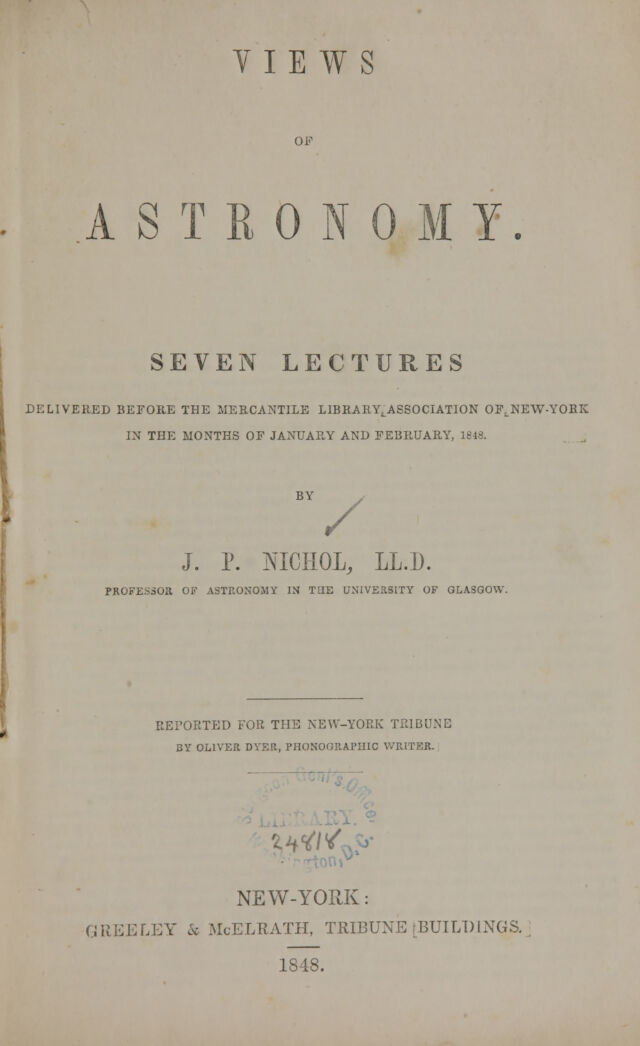
Views of astronomy : seven lectures delivered before the Mercantile Library Association of New York in the months of January and February, 1848 / by J.P. Nichol ; reported for the New-York Tribune by Oliver Dyer.
- John Pringle Nichol
- Date:
- 1848
Licence: Public Domain Mark
Credit: Views of astronomy : seven lectures delivered before the Mercantile Library Association of New York in the months of January and February, 1848 / by J.P. Nichol ; reported for the New-York Tribune by Oliver Dyer. Source: Wellcome Collection.
Provider: This material has been provided by the National Library of Medicine (U.S.), through the Medical Heritage Library. The original may be consulted at the National Library of Medicine (U.S.)
40/52
![LECTURE VII. Constitution of the SUN....Discovery of spots on his surface and the rotation of the orh....Nature of these spots.... H'he solar atmosphere....Inquiry and speculation concerning the cause of the spots....Striking similitude with terrestrial atmospheric commotions or storms... .Probable existence of other changes in the Sun.... Conclusion of the Course. Ladies and Gektlemew: On the last evening, I opened to yon in the cursory manner which alone is in accordance with a coarse so brief as this, the question of the pecaliar constitution of the several planets which, with the Earth, roll round the San. In the coarse of that lecture we looked especially at the Moon, and I think we saw causa to modify, somewhat, the conclusion usually drawn by geolo- gists from the several modes of its development in Earth, respecting the ultimate character of those grand causes that have so universally upheaved the surface of all these planets. The conclusion we would be disposed to draw from first sight is, that this cause is a central one; but I think we showed that this could not be the case. Those changes, however, to which I then allu- ded, are merely a few scenes in the history of the planets. Now, what are these in re- lation to our whole System 7 Incidents them- selves in the condensation of the Sun, just as their internal geological epochs are incidents in the course of their own, how utterly they shrivel and vanish from sight, when we turn to that Orb himself whose history,in very truth,the history of our System solely is. I think 1 stated, on a previous evening, the fact that the diameter of the Sun is so enormous when compared with the other bodies in our system, that if the Sun be repre- sented by a globe two feet in diameter, Jupiter would be represented by a ball no larger than an orange, and our own Earth by a speck only. The phenomena that first led to some knowledge '■of the constitution of this vast Orb, are those curi- ous spots that appear and disappear so frequently on his surface, and which by their regular pro gr ess ion across his disc, revealed to their first dis- coverer, Galileo, the remarkable fact that the Sun rotates on his axis like the planets, carrying the spots along with him. We find, on examining the 8un with a good Telescope, that rarely a day occurs in which his surface is not marked by dark spots which fre- quently appear with great suddenness, and disap- pear with exceeding rapidity. This was one of the earliest discoveries of Galileo. On looking at them, he found they were not fixed upon the Sun's surface, but were continually changing their places. Now, on endeavoring to ascertain what the cause of this change was, he discovered that all the spots moved in one direction, and also in definite curves. He found that all these pheno- mena might be explained by the supposition that the Sun is an immense globe taming on its axis. He detected from this, also, something like an ap- proximation to the time required by the Sun to perform one revolution on its axis. He estimated the period to be about twenty five days. Before another step was taken in this inquiry, very many years elapsed; nor was the light they cast on the nature of the substance and constitution of the Sun recognized until the times of Dr. Alex- ander Wilson and Sir William Herschel,—the for- mer of these eminent men, earliest beyond a doubt, establishing the cardinal act in this high Inquiry Some remarkable features that invariably charac- terize a Solar spot, had attracted his attention and accident as he modestly said—but of course one of those accidents that can be taken advantage of by Genius, enabled him through them to read tho whole significance of the phenomena. The fea- tures in question are these. The spots that attracted Dr. Wilson's attention— a man whom I am proud to name as my almost im- mediate predecessor—were as follows : In 1769, a large spot broke oat in the middle of the Sua which attracted the attention of all the Astrono- mers of that time. He noticed that this spot was moving onward, ami that as it passed across the surface of the Sun, a very singular series of changes occurrred. When in the Sun's center, ths spot presented the following phenomena, just as in the fact do all the spots on the Sun's surface : He found that the center was the only portion of the spot that was quite dark. Around the center he found an edgiDg, which he called the Umbra. As the spot went forward, the Umbra diminished; and when it went on still farther the Umbra disap- peared, and nothing but the edging on the side op- posite himself was visible. [Here the Lecturer referred to a couple of largo diagrams, represent- ing the various phenomena presented by these Solar spots] In explanation of these phenomena, Wilson formed a very ingenious theory. He said, if this large spot lasts long enough for the Sun to bring it round again, I shall see the following phenomena: As it comes round, 1 shall see, first, the opposite edging, and as it comes on down to the center of the 8un, I shall see the spot with its black center surrounded with the edgings. Well, the spot did continue long enough for Wilson to make the de- sired observations, and he found his predictions in every respect verified. [The Lecturer here ex- hibited, by means of a common globe, the course of reasoning pursued by Wilson in the formation of his theory.] It followed at once, from Wilson's capital dis- covery, that our magnificent Luminary is not a cha- otic conflagration, but a body having a definite or- ganization, revealed in so far by the aspects of these openings; and to the solution of the momen- tous question as to what this organization is, the singular powers of the elder Herschel came quickly in aid of the efforts of his friend. With both of these illustrious men, it early became a fixed be- lief that the surface thus broken by chasms must be aerial—or some elastic gaseous fluid like our atmosphere; lor notwithstanding the magnitude of these spots, sometimes reaching even 50,000 miles in diameter—they open and close with a rapidity next to marvelous, often surpassing the rate of 1,000 miles a day. Nowhere, perhaps, in all the annals of disco- very, is there aught that more stirs thought or raises more strange questions than this ! Let us see into what it summons ua to inquire.](https://iiif.wellcomecollection.org/image/b21143821_0040.jp2/full/800%2C/0/default.jpg)